Introduction
Money, the thing that drives the modern economy, which has even shaped our society, still leaves one question floating in the back of our heads: how does a single piece of paper hold so much value in our society? And why do we even use paper for the exchange of goods and services?
To answer that, we will look at the different types of things used by ancient economies and how we have reached this far to accept a piece of paper as something valuable.
What is Money
In layman’s language, “it is an accepted medium of exchange,” which means a thing people would accept in exchange for goods and services. This means you can use anything to buy goods and services, literally anything, even your home trash, as long as the seller agrees to it.
With that, let’s dive into the first economy our human ancestors lived in.
Barter Economy
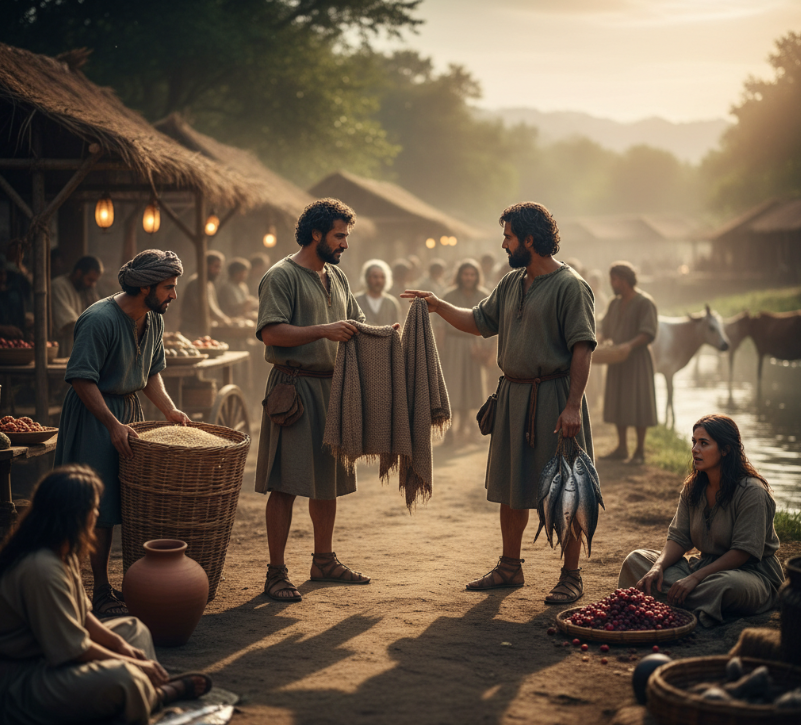
In this economic system, humans directly exchanged goods and services for other goods and services without any medium. For example, Mr A has clothes and wants to buy fish. Mr B has fish and wants clothes. That’s great, they can simply exchange with each other and fulfil their needs.
But there were a lot of problems with this system.
Problem 1: Coincidence of Wants
In the above example, both Mr A and Mr B want what the other has, so the transaction works. But what if Mr B doesn’t want clothes and instead wants rice, while Mr A still wants fish? Now they are stuck. Mr A has to find another vendor to trade his clothes for rice, and then use that rice to buy fish. You can see how this system quickly becomes hard and confusing.
Problem 2: Determining the Value of the Product
Let’s assume both Mr A and Mr B agree to trade clothes and fish. How will they determine the value of the transaction? How many fish equals one shirt? Without a common medium, it becomes very hard to determine the real value of a product.
Problem 3: Savings
People selling perishable products like food had no option but to save their goods for long-term use, which meant they had to complete all transactions before their product spoiled.
Problem 4: Transaction Size
This system also limited the size of transactions. Mr B doesn’t have a family big enough to use 500 clothes, and Mr A can’t eat 100 kg of fish. So, large-scale transactions were nearly impossible.
By this point, it’s clear that this system was a headache for both buyer and seller.
Commodity Money
To escape the hardships of the barter system, humans started using specific products or materials as intermediaries of exchange, as long as they were rare and hard to destroy or tamper with.
At first, you might think gold and silver were the first choices, but instead, early civilisations used ivory shells.
They were perfect because they were hard to find and impossible to tamper with. Later, gold and silver took their place.
This system worked so well that it still exists in some parts of the world, like prisons in the U.S., where cigarettes are used to buy and sell goods secretly.
But even this system had problems.
Problem 1: Limited Economic Expansion
When an economy grows, more transactions occur, requiring more currency. If your economy depends on precious metals with a limited supply, that’s bad for growth.
Problem 2: Counterfeiting
Using something that has real value to determine value invites counterfeiting.
People used to shave small amounts from gold or silver coins and melt them into new ones. Even governments mixed impurities into coins to create more currency from the same resources.
Problem 3: Difficult to Handle Large Transactions
Commodity money allowed bulk trade, but transporting large amounts of gold or silver was risky and heavy. Imagine moving half a ton of gold in the 1800s, a perfect setup for a robbery.
Paper Money
As transporting gold and silver became risky, the banking system was introduced, accidentally, by the Crusaders (a story for another time).
Here’s how it worked:
Suppose you need to do a large transaction but don’t want to risk carrying gold or silver. You deposit your gold in a bank, and the bank gives you a receipt (IOU). You then give this IOU to the dealer as proof that you have the money. The dealer could go to the bank, surrender the IOU, and redeem the gold.
However, banks noticed most IOUs were never redeemed. People started using these IOUs repeatedly for multiple transactions. Realising this, bankers began printing more IOUs than they had gold a system now known as fractional reserve banking.
This system worked entirely on trust the belief that not everyone would demand their gold back at once. If they did, the bank would collapse.
Still, this idea became the stepping stone for paper money.
In the 18th and 19th centuries, paper money gained popularity, especially in Europe. The Netherlands became the financial hub of Europe despite having no natural resources, using innovative tools like stocks, insurance, and paper money.
But at that time, there were no central banks. Each bank printed its own IOUs, so a note from one bank might not be accepted elsewhere or might be worth less.
To fix this, the Bank Charter Act of 1844 gave the Bank of England sole rights to print banknotes. Other countries followed, giving their governments control over currency printing backed by gold and silver.
Removal of the Gold Standard
The removal of the gold standard is a controversial topic.
During World War I, countries like Britain and France abandoned it to print more money for war expenses, causing post-war crises like Germany’s hyperinflation.
After World War II, the Bretton Woods System was created. The U.S. dollar was tied to gold, and other countries held dollars as reserves instead of gold.
In the 1960s, France demanded gold in exchange for its dollar reserves, and other countries followed. In the 1970s, President Nixon ended the gold standard for the U.S. dollar.
To everyone’s surprise, the dollar didn’t collapse because global trade depended on it. The dollar continued to hold its value, becoming the universal reserve currency.
Conclusion
What we learned is that the modern financial world is built on trust.
From barter to paper, humanity has come a long way.
So, the next time you see a bill in your pocket, remember that mankind faced centuries of trial and error to get here.
Yes, cryptocurrency exists, but since it’s not widely used as a primary currency yet, it’s not discussed here.