Even your wallet is going to feel like a million bucks during this million-dollar Bachat Utsav shopping spree. The wait is over to turn your dreams into reality. A wave of excitement surged through the bustling market as customers left with armfuls of shopping bags, each filled to the brim with ‘Made in India’ products. The paradisiacal combination of Swadeshi 2.0 and Next Gen GST reforms is hitting the dopamine for both retailers and shoppers in shopping malls.
Whether a sports enthusiast or car fanatic, Bachat Utsav has you covered without breaking your bank. Smashing the stagnant market for five to six years, the GST cuts will light up the entire nation’s Diwali. This year’s Navaratri sales have demonstrated unprecedented market performance, surpassing all previous records over the past decade. The Cost of Sales (COS) is skyrocketing with a booming market, varying from 25% to 100%.
Who says money can't buy happiness? With less money and more shopping, you're just a receipt away from joy!
The Chronicle of GST:
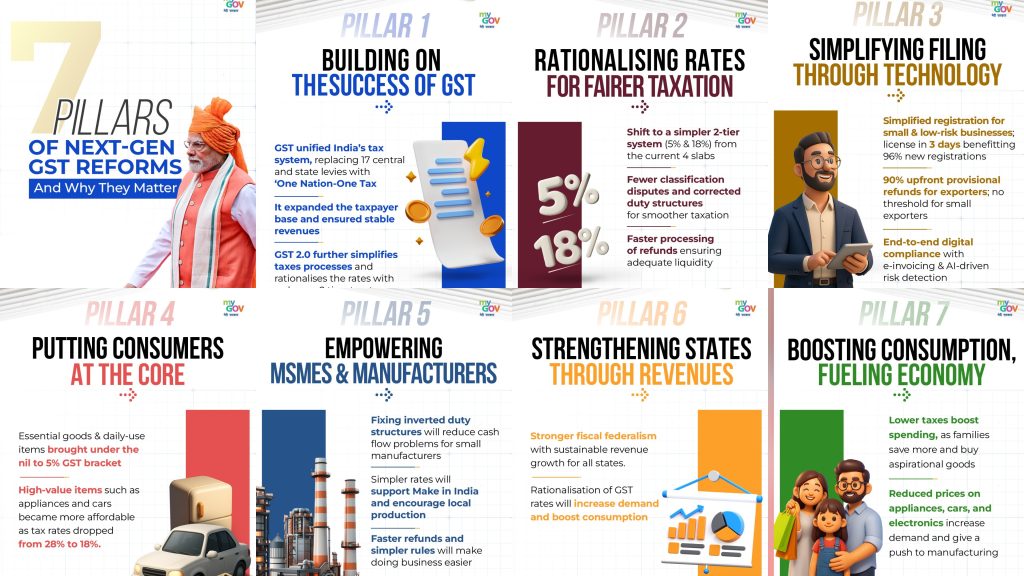
The landmark 122nd Amendment Bill 2014 implemented the Goods and Services Tax w.e.f. July 1, 2017, by simplifying the tax structure and unifying both the centre and state taxes uniformly. The initiative not only substituted the labyrinthine and disintegrated tax structure but also dwindled the cascade tax and fostered economic integration.
A ray of sunshine gleamed as the multi-slab tax structure dismantled, with 5% and 18% slabs emerging as the Rakshak (protectors) of the Indian economy. Roaring from the Red Fort on August 15, Prime Minister Narendra Modi declared Double Diwali, making the GST structure a breeze for MSMEs and industrialists.
The deep state and foreign powers may attempt to undermine our nation, but the people of India and the Government of India stand united as a formidable shield by committing to buy and support ‘Made in India’ products. The Next-Gen GST reforms are an icing on the cake to safeguard the world’s fourth-largest economy, which is projected to jump to the third level by 2030.
Be a brand ambassador of ‘Vocal for Local’:
Prime Minister Narendra Modi exhorted natives to become architects of Atmanirbhar Bharat by celebrating this festive season with Swadeshi products, as they are meticulously made by the sweat, blood, and tears of Indians, including women, local artisans and small industries.
Garv se kaho, hum Swadeshi hai: PM Modi
Deep-rooted in the hearts of Indians, the Swadeshi movement echoes the voices of the freedom struggle. It not only broke the shackles of the colonial era but also resuscitated our indigenous economy.
The fervent nationalist sentiment sparked as Indians mustered courage for the Swadeshi movement, standing tall. Just like Lord Hanuman, Indians realised their worth after boycotting foreign products and vowing to use domestic goods in the Swadeshi movement. The Swadeshi movement evoked challenging the hegemony of the British and fostering self-reliance.
Swadeshi 2.0 serves as a bugle call to the Global North and Western powers, placing itself strategically in international dynamics. From Uncle Sam (US) to the Dragon (China), each country has to weigh all options when it comes to making any decision that affects ‘Sone ki chidiya – Bharat’.
Spirit of Swadeshi carries with it the idea of self-reliance and self-restraint, which is the exact test of human efficiency.
M.K. Gandhi
The vision of Bapu is always reflected in Prime Minister Narendra Modi’s policies and initiatives, as PM Modi himself affirmed. The ruling government has consistently insisted that Indians adopt Khadi – the soul of Gandhi. Grassroots initiatives such as Digital India, Swachh Bharat Abhiyan, Har Ghar Jal, and Atmanirbhar Bharat, by PM Modi, were fueled by Bapu’s vision and mass movements led by him. In the same spirit, PM Modi urged Indians to kindle the spirit of Swadeshi in each house and shop as a mantra for India’s economic expansion.
Every move is chess, not checkers:
Name, ‘sanctions’ or ‘POTUS’s 50% tariffs’; India is well-equipped to remain unaffected by any global atrocity. This Aatmanirbhar Bharat not only defends itself but also gives a befitting reply to geopolitical players or frenemies. From GST reforms to Swadeshi 2.0, everything is a pre-determined, calculated approach to fix the fabric of the economy. Amrit Kaal is all set to witness the dawn of economic growth and stability for 146.7 crores of Indians.
Brahmos, Tejas, and many more are a testament to Swadeshi 2.0 in defence exports, which are running at full throttle. Adopting ‘Made in India’ is not putting the brakes on progress but ensuring that jobs, traditions, and trade prosper in our market, even in a volatile international market.
In a period of a multipolar world and deglobalization, Swadeshi 2.0 is a war cry against dependency. On August 15, R-Day, PM Modi’s powerful message was loud and clear: Embrace ‘Made in India’ products with such fervour, pride, and conviction that foreigners not only see and desire them, but are driven to purchase them.
Your shopping mantra: Vocal for Local
PM Modi thundered from the Red Fort to take pride in Swadeshi products and be their staunch advocate. He proudly drew the attention of shopkeepers to display boards that read, “Only Swadeshi Products Sold Here.”
Given India’s position as the fifth-largest global market, major international economies recognise it as a significant consumer-driven economy, where Swadeshi 2.0 can be a game-changer to benefit Indians by Indians.
Vocal for Local is not merely a slogan, but a magnet for foreign investment and surplus employment opportunities for every Indian citizen.
Swadeshi ka Sankalp:
Swadeshi 2.0 has turned out to be a money-saving hack for foreign exchange reserves, as Indians vow for ‘Made in India’ products, which makes it evident that no power in the world can stop India from becoming the third-largest economy. No global power can take your money out of the country, as Swadeshi 2.0 enables the hard-earned money of Indians to stay within the nation.
Some of the flagship Swadeshi brands are Patanjali, Khadi India, Tata, Zoho, Arratai, Amul, Airtel, ITC, etc. To effectively distinguish Indian products from international brands, a clear and prominent display of “Swadeshi” is required on products. Make your recent purchase from Indian brands this festive season.
Prevention is better than cure:
When Indians voice concerns about inflation, the declining value of the rupee against the dollar, and rising unemployment, it’s important to recognise their role as responsible citizens. By choosing to support local brands over foreign ones, they can help stimulate the economy. Every purchase made from international companies strengthens foreign currencies at the expense of the rupee and bolsters the economies of foreign countries.
When domestic demand meets domestic supply, a quantum leap in national GDP and production transforms the economy, reflecting a vibrant and thriving market. Become part of Swadeshi 2.0, a transformative initiative to leverage technological advancements, streamline business operations, foster rural development, and stimulate capital investment.
Why stay home when you can shop till you drop at this Bachat Utsav?
From Kashmir to Kanyakumari, each state is serving a double bonanza for retailers, MSMEs, artisans, farmers, local vendors, manufacturers, and industrialists. The crown of India, Jammu and Kashmir, is reaping benefits from Next-Gen GST reforms in sectors of horticulture (saffron, cherries, walnuts), fishery, and handicrafts such as silk textiles (sericulture), pashmina, carpets, and wood carving. Thangka paintings, Pashmina textiles, wood carvings, dairy, and agricultural machinery are hitting the jackpot in the “Broken Moon land,” Ladakh.
No need to bargain hunt; everything is a steal!
The “Fruit bowl of India,” Himachal Pradesh, has cut the cost of Kullu shawls, cumin, Kangra tea & painting, and more to 5% GST. Low costs are not just a boon for customers but also for local artisans and shopkeepers, as purchasing power has increased.
The Devbhoomi ‘Uttarakhand’ is making people go on a buying binge of Munsyari Rajma (kidney beans), bay leaves (tej patta), Nainital lychee, and handicrafts such as Thulma blankets and Ringaal basketry made by Bhotiya weavers, as their prices have been slashed to the 5% GST slab.
This Diwali, make pakwaan (delicacies) with various tax-free essential grocery items!
The economy of the “Land of forests,” Jharkhand, is gaining momentum as the 5% GST slab has made numerous products affordable, like matrilineal Sohrai–Khovar paintings, metal casting “Dokra art,” golden Tussar silk, and Mahua products (sweets, pickles, fermented alcoholic beverages).
From the textile industry to GI-tagged products like Virupakshi Hill Banana, Erode turmeric, vivid Thanjavur paintings, and 250-year-old Arumbavur wood carvings, inserted under a 5% tax slab, the “Land of temples” Tamil Nadu has levelled the playing field for artisans and farmers.
The first wealth is health; therefore, 0% GST on health insurance and 36 life-saving drugs.
Antique Bastar iron craft, intricate Champa silk sarees, and unique Dokra art are making business boom for artisans and farmers in the “Land of 36 forts,” Chhattisgarh. Alleppey green cardamom, Wayanad coffee, Malabar black pepper, and Alleppey coir products, enjoying 5% GST, are the tailwinds of God’s Own Country, Kerala.
Have beauty, guilt-free with cosmetics under 5% GST, so divas get ready to glam up this festival.
The lifeblood of the “Koh-i-Noor of India,” Andhra Pradesh, such as Tirupati laddoo, Guntur Sannam chilli, Etikoppaka toys, and Kondapalli bommala toys, are turning the shopping game like never before due to 5% tax. Mysore silk, Coorg oranges, Channapatna toys of the “land of sandalwood” Karnataka, and Thirukannur papier-mâché crafts, Villianur terracotta of the “Paris of the East”, Puducherry have also joined the 5% GST party.
Bloom like a rose with affordable skincare and shopping therapy!
The bread baskets of India, Punjab and Haryana, are unlocking economic potential in the market. Phulkari, makhana, handloom textiles, agricultural machinery, dairy, from the Punjab and Basmati rice, Phulkari, mustard oil, dairy, tractors, spices, and solar equipment from Haryana are subject to a 5% tax on sales.
The tango of Kolhapuri chappals, Warli paintings, Paithani sarees, Alphonso mangoes, Nagpur oranges, and Vaigai turmeric, automobiles in Maharashtra are attracting customers with their 5% tax rate.
Odisha, the “Land of Lord Jagannath,” is leaving no stone unturned in enabling natives to celebrate the festival with low costs on silver filigree, Koraput art, Dokra craft, and agricultural and processed food products. Goan khaje, cashews, and agricultural products are setting the stage in Goa, “the Pearl of the Orient,” to light up Diwali.
Slash 5% tax on gym and yoga classes because fitness is not a luxury but a part of a healthy lifestyle.
A breakthrough is observed in poll-bound Bihar, spotlighting Nari Shakti, youth, and small enterprises, with GST cuts in various industries, from textiles to dairy. Handloom, sports equipment, and leather industries are making “India’s Sugar Bowl”, Uttar Pradesh, on par with international standards.

Gujarat, the “Jewel of Western India,” saw a surge in the textile and diamond industries with reduced production costs. The Next-Gen GST reforms align with the commitment of PM Modi to “Sabka Saath, Sabka Vikas, Sabka Vishwas, and Sabka Prayas.”
Joyride for Car fanatics: Drive your dream car home!
- Maruti Suzuki’s Navratri sales doubled, reaching a decade high with 150,000 bookings and 85,000 vehicles retailed.
- Other automakers also saw increased sales, including Mahindra & Mahindra (60% jump), Hyundai (SUVs driving sales), Hero MotoCorp (doubled showroom footfalls), Tata Motors (over 50,000 vehicles retailed), and Bajaj Auto. [Source: MIB]
Power up your life with Affordable Electrical Appliances:
- LG, Haier, and Godrej Appliances experienced high double-digit sales growth this Navratri.
- Haier’s sales increased by 85%, with strong performance in large-screen TVs.
- Reliance Retail saw a 20-25% sales increase, driven by electronics and fashion.
- Vijay Sales also reported over 20% sales growth.
- LG Electronics India reported exponential growth. [Source: MIB]
From Sales to Smiles: Market sentiments
Praveen Khandelwal, General Secretary of the Confederation of All India Traders (CAIT), affirmed that “Diwali 2025 is expected to see record sales of ₹4.75 lakh crore, driven by a preference for indigenous products fueled by government initiatives and the significant purchasing power and entrepreneurial contributions of women. This festive season highlights India’s economic progress, cultural confidence, and women’s empowerment.”
Sanjay Jaiswal, a chemist from Maharashtra, has indicated that the absence of taxes on medicines has not only made them more affordable but has also provided relief to the medical market.
GST cuts and goods prices sparked consumer sentiment, enabling products to sell like hotcakes.
The Indian call of duty:
- Promote Swadeshi products.
- Use Made in India products.
- Be informed about indigenous goods.
A key characteristic of Global North nations is their strong domestic manufacturing and consumption, which bolsters local industries and economies. By prioritising self-reliance and supporting homegrown businesses, India can avoid the burden of rising costs for imported goods. It’s time for Indians to wake up and smell the coffee; with unity and innovation, we can accelerate our journey toward becoming a developed nation. Let’s embrace our potential and inspire each other to thrive!
Every section of society will be shopaholic at the Bachat Utsav because good deals are everywhere. Shop more, Save more!