Have you ever imagined yourself, at some point in life, getting down on one knee, opening a velvet box, and revealing a sparkling diamond ring, a symbol of love, commitment, and forever?
Why wouldn’t you? We’ve all been told that diamonds are rare, expensive to mine, a great investment, and most of all, eternal. After all, “A diamond is forever.”
But if I tell you that everything you’ve believed about diamonds so far is, in fact, a myth.
Diamonds are not rare; they’re actually quite abundant in nature. They are not difficult to mine, have never been a reliable investment, and frankly, a diamond is not forever.
So how did an ordinary piece of carbon become a universal symbol of luxury, status, and eternal love?
Let’s unfold the glittering illusion behind the global diamond monopoly and how a single company transformed a common rock into a timeless obsession.
What is a Diamond, really?
If you’ve always believed that diamonds are made of some rare, extraterrestrial substance, you’re in for a big surprise.
At its core, a diamond is simply carbon, the same element found in charcoal, pencil graphite, and even in your own body. What makes it special is not the element itself, but the way its atoms are arranged.
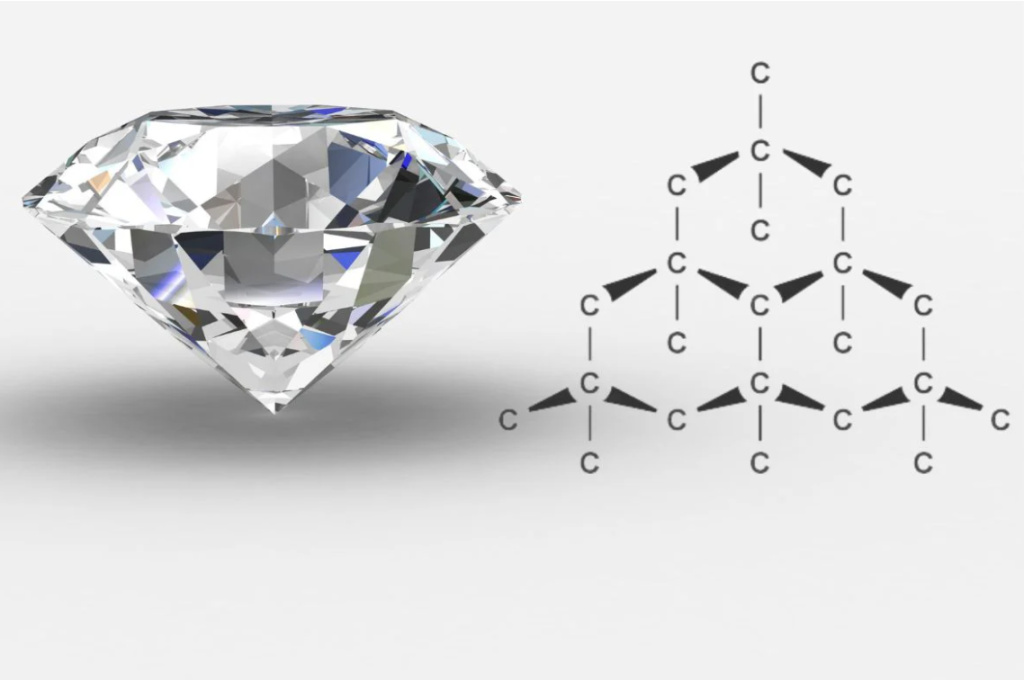
Diamonds are formed through isometric (or cubic) bonding, where each carbon atom is tightly bonded to four other carbon atoms in a crystal lattice. This incredibly strong and stable structure gives diamonds their legendary hardness.
The image shows the atomic structure of diamond. Credit: Diamondrenus
Interestingly, graphite, the soft, flaky material in your pencil, is also made entirely of carbon. The difference? Graphite’s carbon atoms bond in layers of three, creating a much weaker structure. So yes, the only thing separating a diamond from pencil lead is the geometry of the bonds.
The history of diamonds doesn’t start in luxury stores or engagement rings; it starts in the riverbeds of ancient India, over two thousand years ago.
As far back as the 4th century BCE, Indian villagers discovered these radiant stones shining in the river sands of the Krishna and Godavari. The diamonds weren’t regarded as symbols of love or prosperity. Rather, they were valued for their spiritual and mystical properties, said to ward off evil forces and bestow good luck. Kings and nobles carried them as talismans instead of jewellery.
India, for centuries, was the sole source of diamonds in the world. As trade routes continued to open up around the globe, especially along the Silk Road, diamonds started moving to the West. In the Middle Ages, European aristocrats got word of these glamorous and otherworldly stones.
When the Portuguese and other European explorers started colonizing parts of Asia, India was already sending not only spices and textiles but also copious amounts of rough diamonds. These gems soon became popular among the European aristocracy, who considered them a sign of royalty, power, and divine Favor.
But even as they gained increased popularity, diamonds remained comparatively out of reach for most people. That would all change in the centuries ahead, not due to diamonds becoming less available, but through powerful firms figuring out how to dominate their supply and control their price.
The Commercialization of Diamonds: A Monopoly in the Making
The modern diamond industry in its current form, however, made a dramatic pivot in 1866, when a kid named Erasmus Jacobs stumbled upon a gleaming 22-carat gem along the banks of South Africa’s Orange River. That gem was a diamond, and it set off what would become known as the Great South African Diamond Rush.
By the 1870s, South Africa was a diamond prospectors’ and entrepreneurs’ hotspot. Among them was Cecil Rhodes, a British entrepreneur who first leased water pumps to miners before establishing his own mining business, De Beers Mining Company, in 1888.
As it mined more, something peculiar occurred: diamonds continued to surface. In huge amounts.
It didn’t take long for diamond owners to recognize an unwelcome fact: diamonds were far from scarce. They were much more plentiful underground than anyone could have predicted. As European markets became inundated with diamonds, prices collapsed, and many mining operations went bust as revenues fell.
But Cecil Rhodes envisioned something else. Instead of conceding defeat, he chose to take matters into his own hands. With the financial support of the influential Rothschild family, Rhodes started purchasing insolvent diamond mines all over South Africa. His strategy was straightforward yet genius: dominate the supply of diamonds in order to dictate worldwide prices. But how would limiting the available diamonds drive their value up?
Let’s make a brief trip into economics.
Understanding Demand and Supply
In order to gain a proper perspective of Rhodes’ strategy, we must know three important economic principles:
1) Law of Supply
According to this law, if the supply of a product increases, its price decreases, and conversely, if supply goes down, prices go up. In short, there’s an inverse relationship between supply and price.
2) Law of Demand
According to this principle, when demand for a good rises, so does its price. Conversely, if demand falls, prices drop too. Demand and price share a direct relationship.
3) Relation between Demand and Supply Curve

The relationship between demand and supply decides the equilibrium price of a product in the market. If a company has the ability to control one side of the equation — demand or supply — it can control prices.
How Rhodes Built a Diamond Empire
By purchasing almost 90% of the world’s supply of diamonds, Cecil Rhodes had unprecedented market control. He then established a dominant diamond cartel known as De Beers Consolidated Mines Ltd., which functioned through an extensive network of sister and shell companies to conceal its monopoly.
Among such dominant companies were:
• Diamond Development Corporation (Africa)
• Central Selling Organisation (Europe)
• Diamond Trading Company (England)
Through these companies, De Beers controlled mining, sorting, valuing, and selling diamonds on continents, all while tightly controlling supply to sustain price and the illusion of rarity.
This strategic control turned De Beers into one of history’s most influential monopolies, not only ruling an industry but influencing culture, love, and luxury itself.
“A Diamond Is Forever” — The Marketing Masterstroke
It was 1929, and the world was in the midst of the Great Depression. Firms were folding, the unemployed were lining up in droves, and luxury items were the last priority on people’s minds. For De Beers Consolidated Mines Ltd., all this economic downturn meant a serious crisis. Their model was based on an uninterrupted demand for diamonds, but as wallets grew thinner, diamond sales tanked, and the company was staring at huge financial losses.
At this time of trouble, De Beers brought in N.W. Ayer & Sons, the foremost advertising firm, is to assist in saving the diamond industry. The agency’s task? To persuade a financially strapped public that diamonds were not only a symbol of luxury, but also an investment staple.
Enter the iconic slogan: “A Diamond Is Forever.”
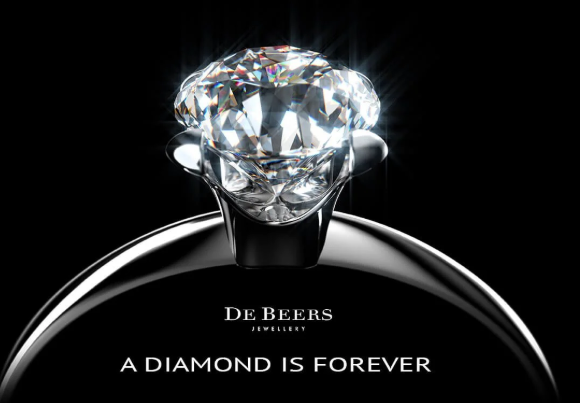
This four-word slogan did more than market jewellery; it redefined commitment, marriage, and love for generations. Diamonds were no longer beautiful pieces of stone; they were made into a statement of forever love. The message was definitive: if you loved someone, you sealed it with a diamond.
But the genius of the campaign didn’t end there.
De Beers and N.W. Ayer tactfully positioned diamonds not only as romantic presents, but as precious, long-term investments, both emotional and monetary. The company started compensating Hollywood performers and international celebrities to wear diamond jewellery on television and at public outings, further solidifying the connection between diamonds and high status.
By the 1950s and ’60s, the diamond engagement ring had become a social norm, not a luxury. Indeed, in much of the Western world, virtually 80% of brides were being given a diamond ring by the close of the 20th century, a revolutionary cultural development generated by a single campaign.
De Beers had pulled the impossible: they had created demand, manipulated supply, and woven a story so emotionally powerful that it rooted itself in society’s very own imagination.
The Present Day: A Fading Empire
By the early 2000s, fissures started to show in the glistening façade of the international diamond empire.
Investigative news and increasing public knowledge revealed the monopolistic strategies of De Beers and its large network of shell and sister companies. What was previously concealed, an almost complete dominance over the world diamond supply, was now vocally criticized. Under increasing legal scrutiny and changing market forces, the De Beers monopoly was slowly unravelled.
That was just the start of their fall.
But since the last few years, the diamond market has witnessed two major challenges:
1. The Emergence of Lab-Grown Diamonds
Technologically equivalent to natural diamonds, lab-grown diamonds are produced in labs, are much cheaper, and do not carry the ethical burden of conventional mining. Consumers, particularly younger ones, are now more and more opting for lab-grown diamonds, prioritizing sustainability and low cost over conventional.
2. Concept of Red Diamonds
The phrase “blood diamonds” or “red diamonds” is now used to refer to natural diamonds that are produced in conflict areas or in exploitative conditions. Public outcry against such practices has been the motivation for widespread demands for reform, responsible and ethical sourcing.
Consequently, De Beers’ market dominance is fading. The firm’s revenue fell from $2.8 billion in 2023 to $2.2 billion in 2024, which is not only a sign of financial downturn but rather an indication of a deeper change in consumer values and market tastes.
The ring that once stood for timeless love and opulence is today being reassessed based on ethics, economics, social and environmental stewardship.
The diamond, it appears, is no longer forever.
Conclusion: The Glittering Illusion
So, what have we truly learned?
- That diamonds are not rare.
- They can be created in laboratories without ever touching the earth.
- That they are not sound investments, despite the decades of marketing.
- And perhaps most surprisingly, that a diamond is not forever. Heat it to 763°C in the open air, and it will simply vaporize into carbon dioxide.
The myth of the diamond was never about Geology; it was about marketing, manipulation, and monopoly. For most of the 20th century, a single company controlled and dominated the entire global supply chain. While the days of a full-blown monopoly are behind us, however, the diamond market is still influenced by a handful of powerful players who shape demand, prices, and perceptions.
Today, as lab-grown diamonds rise and consumers question the ethical roots of their purchases, the sparkle of the old diamond narrative is beginning to dim.