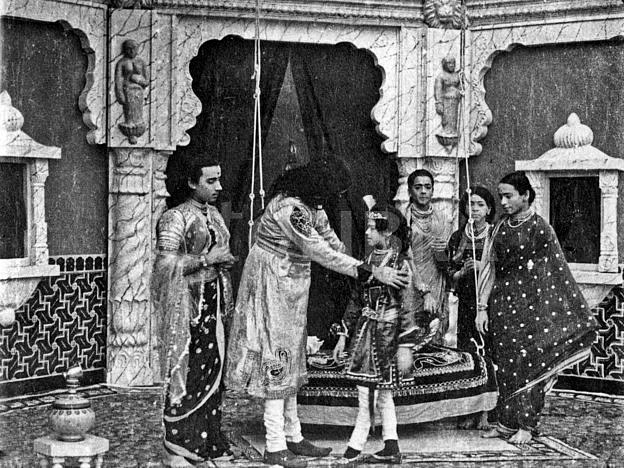
Bollywood, India’s Hindi language film industry based in Mumbai, has evolved over a century into one of the world’s most successful and influential film industries. Known for its vibrant storytelling, song and dance performances and larger-than-life characters. While it’s often associated with romance and glamour, the industry has truly evolved from silent films to representing India on a global stage. The beginnings of the Hindi film industry were ever so humble and rooted in social, cultural, and political themes that captivated the audience a century ago as well.
The origins of Bollywood
The origins of Bollywood can be traced back to the early 20th century, during the British colonial era. The first moving pictures were screened in India by the Lumière Brothers in 1896 at Bombay’s Watsons Hotel, but it wasn’t until 1913 that the Indian film Industry was truly born. It began in 1913 with the release of ‘Raja Harishchandra’, a silent black and white film directed and produced by Dadasaheb Phalke, regarded as the father of Indian cinema. It was the first indigenously made narrative film which a full story, sets, etc, made by Indians. Inspired by early European cinema and mythological tales from the Mahabharata, Phalke taught himself filmmaking and believed Indian stories could be told through this new visual medium. After selling his wife’s jewellery to fund the project, he released Raja Harishchandra on May 3, 1913, a date now celebrated as National Film Day in India. The 20-minute film became a commercial success and proved that there was a market for Indian-made films, which set the tone for the mythological and moral storytelling that would become a staple of early cinema.
Bollywood through the decades
Over the next two decades, Indian cinema began to expand rapidly, which gave birth to studios like Bombay Talkies (est. 1934), Prabhat Studios, and New Theatres. Many of these films were silent until the release of Alam Ara in 1931, the first Indian film to introduce dialogue, music, and songs to cinema. This era gave rise to musicals, a genre that would later define Bollywood.
The post-independence era, 1950s and 1960s, is often described as the ‘Golden Age’ of Bollywood. Directors like Guru Dutt, Bimal Roy, and Raj Kapoor created films that blended artistic depth with mass appeal. Most films during this era, like Pyaasa and Mother India, touched on themes of Social Justice and Nationalism.
In the 1970s and 1980s, Hindi cinema embraced the action-drama genre, with superstar Amitabh Bachchan leading the “angry young man” wave in films like Zanjeer and Deewaar. This era also saw the rise of commercial masala films that merged romance, drama, comedy, and music in films.
The 1990s brought a wave of globalisation. With the growth of the Indian diaspora, Bollywood films like Dilwale Dulhania Le Jayenge achieved cult status worldwide. Shah Rukh Khan, Aishwarya Rai, and other stars became international icons.
Bollywood has continued to evolve over the years with technological advancements, global exposure, Digital platforms, cross-border collaborations with international artists, and a shift toward more realistic storytelling are redefining the industry. Bollywood continues to be a cultural force, reflecting the dreams, struggles, and stories of billions of people. Bollywood’s history is not just a timeline of movies but a mirror to India’s social and cultural transformation.