A new advance has been made in data storage using the old ways. Cassette tapes are making a comeback in a way no one would have thought. Scientists have found a way to combine DNA’s storage capacity with the convenience of a 1980s cassette tape, presenting what they called as a DNA cassette.
At the Southern University of Science and Technology in Guangdong, China, Xingyu Jiang and his colleagues created the DNA cassette.
They printed synthetic DNA molecules onto a plastic tape such that its sequence maintains the order of the DNA bases (A, T, C, G) and represents digital information, just like the 0s and 1s in a computer. This suggests that now we can store multiple digital data such as video, audio, text and images.
How does this work?
Scientists have incorporated a DNA cassette tape with 5.5 x 10⁵ addressable data partitions, with the addressing rate up to 1570 partitions per second. Each physical partition has a unique address, and DMRM is supported.
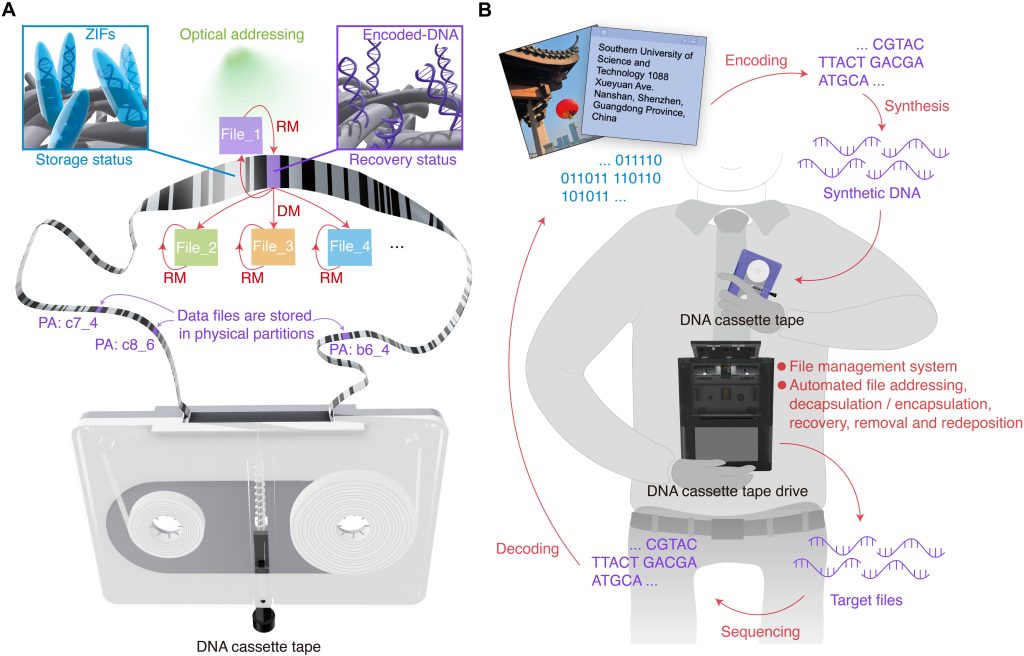
A DNA loading capacity of 28.6mg per kilometre with a deposit-many-recover-many (DMRM) feature per partition is involved to flexibly manage large-scale storage data and achieve hundreds of years of data preservation.
The encoded DNA is protected by a Zeolitic imidazolate framework (ZIFs) layer, and it can quickly be generated and removed before and after DNA recovery. For long-term data storage, this layer is synthesised on DNA tape in situ, with rapid encapsulation within 10s, and decapsulation within 10min on DNA tape.
To perform file addressing, encapsulation, decapsulation, redeposition, recovery, and removal operations onto a DNA quickly and automatically, a DNA cassette tape drive is used, which is included in this set.
In response to the problem faced by the earlier DNA storage techniques, like difficulty in accessing data, scientists have overlaid a barcode series on the tape to help with retrieval. “This process is like finding a book in the library,’’ says Jiang. “We first need to find the shelf corresponding to the book, then find the book on the corresponding shelf.”
What are its advantages?
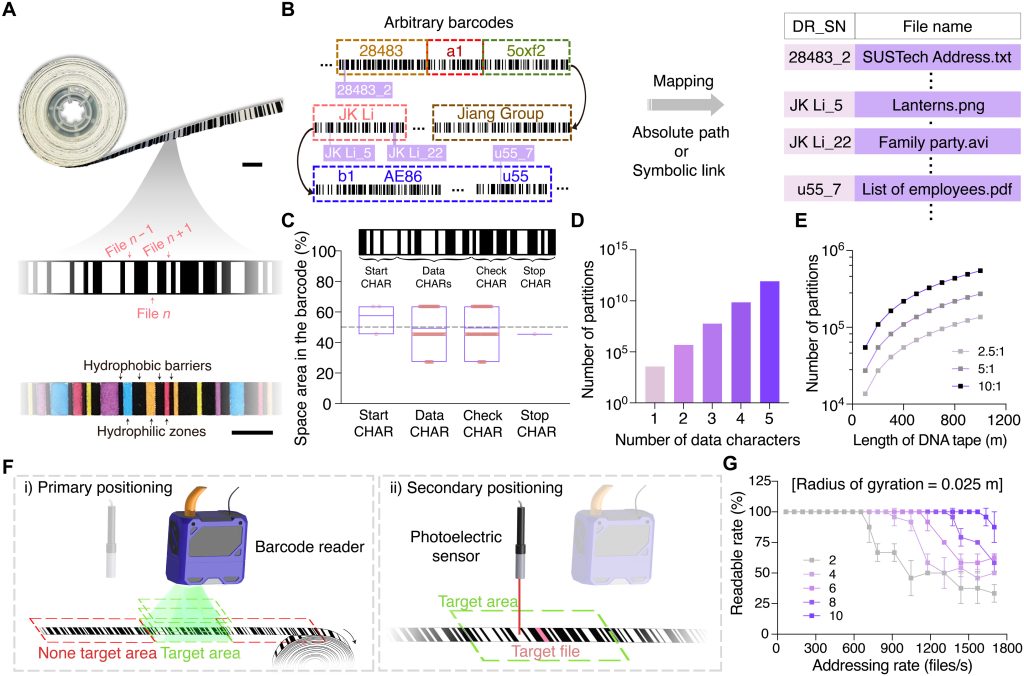
New DNA cassette tape could store about 3 billion pieces of music with only a hundred metres of DNA tape even if the size of each song is ten MB. With the total data storage capacity of thirty-six petabytes of data, equivalent to 36 thousand terabytes of hard drives.
It is no less than a game-changer to use DNA, found only in living things, to solve the global explosion of data growth and become a powerful personal storage memory that can be integrated into a compact device to handle large-scale data.