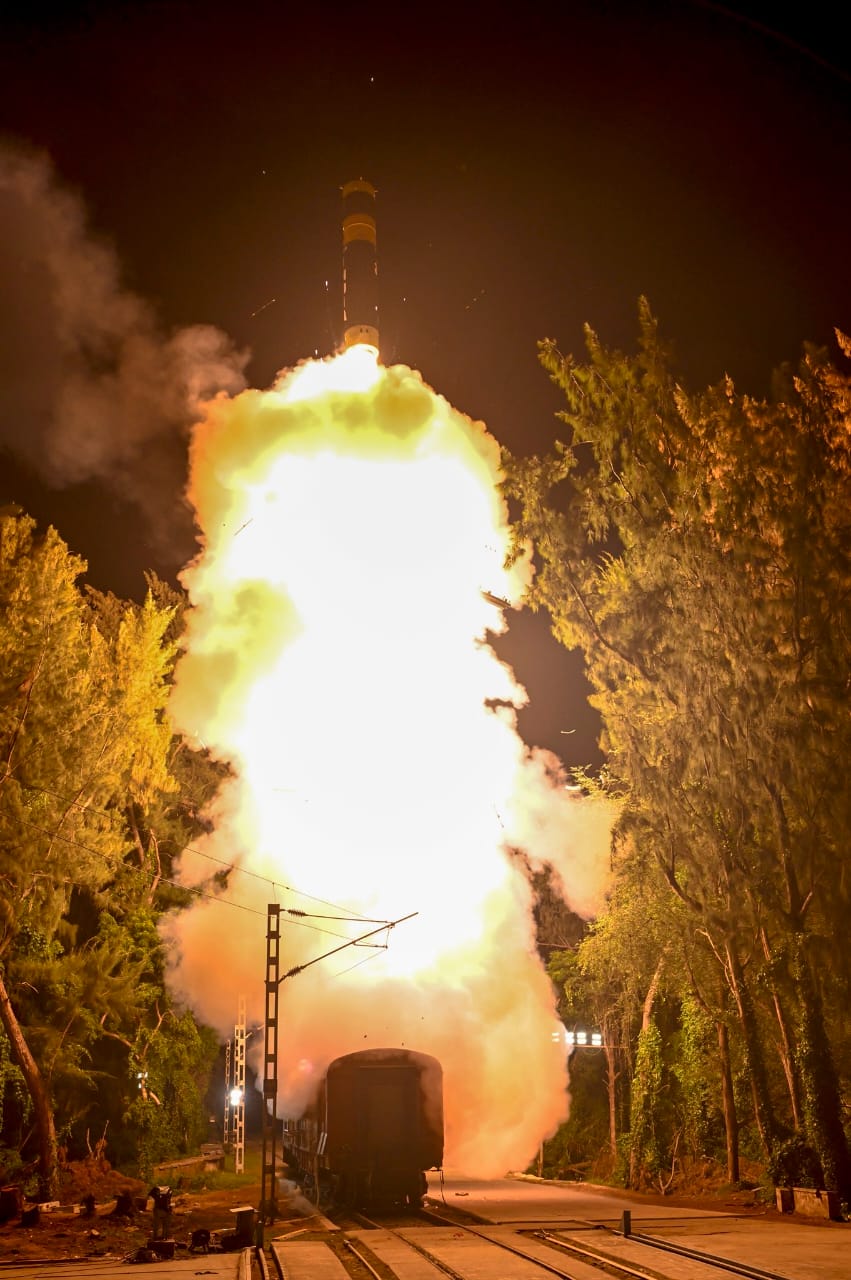
India has moved closer to the rank of powers with advanced nuclear missile launch capabilities with the successful test of the Agni Prime missile from a rail-based mobile launcher. This is the first-ever testing of such a system in the country. The test, jointly conducted with the Defence Research and Development Organisation (DRDO) and the Strategic Forces Command (SFC), was carried out under near-full operational scenario conditions on September 24, 2025.
The absence of an official statement regarding the precise location of the launch appears to be due to security reasons; however, advanced radar, measurements, and monitoring systems along the missile’s path tracked it very closely.
Defence Minister Rajnath Singh applauded the feat in Milestone Major and declared that now India can claim a place in an exclusive club of nations that can launch nuclear-capable missiles from trains. He stated that this rail-based launcher can roam around India through wide railway networks without special tracks, giving India much enlarged movement, flexibility, and reduced visibility for deployment.
Agni-P, or Agni-Prime, is a new-generation medium-range ballistic missile with a strike range of up to 2,000 km. It is lighter, more advanced, and more responsive than those in the older Agni series. This missile has all the latest systems of guidance, such as navigation, which could be boosted optionally by GPS/NaVIC, which gives accuracy at a premium.
Designed for enclosed launching, the Agni-Prime has the added advantage of being stored and transported with very little preparation time before launch. Compared to the longer Agni-5, which has a range in excess of 5,000 km, Agni-Prime serves to strengthen regional deterrence by virtue of rapid deployment and flexible movement. It is most compact, with precision being the prime consideration, and therefore becomes an ideal candidate to be included in the Indian nuclear arsenal that emphasises credible second-strike capability in accordance with India’s ‘no first use’ nuclear doctrine.
Rail-based launchers are game changers for the strategic balance of military operations. Fixed launch pads, which are traditional, can be destroyed by a pre-strike, with the movement on the country’s vast rail network, and its rail-based systems have made the approach much more difficult for the opponents.
More so, blending with civilian train movements, these systems can reposition themselves quickly on the tracks, using remote track systems or tunnels to further enhance their survivability, so that India will be able to execute some form of retaliation in the scenario of a surprise attack. This factor strengthens in a direct way India’s second-strike capability, which is essential for developing a credible nuclear deterrent.
The successful test has placed India alongside the global giants- the United States, Russia, and China, who have all developed their own capabilities for rail-based missile launch. It emerged soon after India tested the Agni-5 missile in August 2025, which boosted India’s long-range deterrence.
The successful Agni Prime launch based on the rail thrust adds not only the strength of the national defence but also a historic quantum jump in cementing India’s nuclear deterrent, signifying technology and strategic vision into the long term.