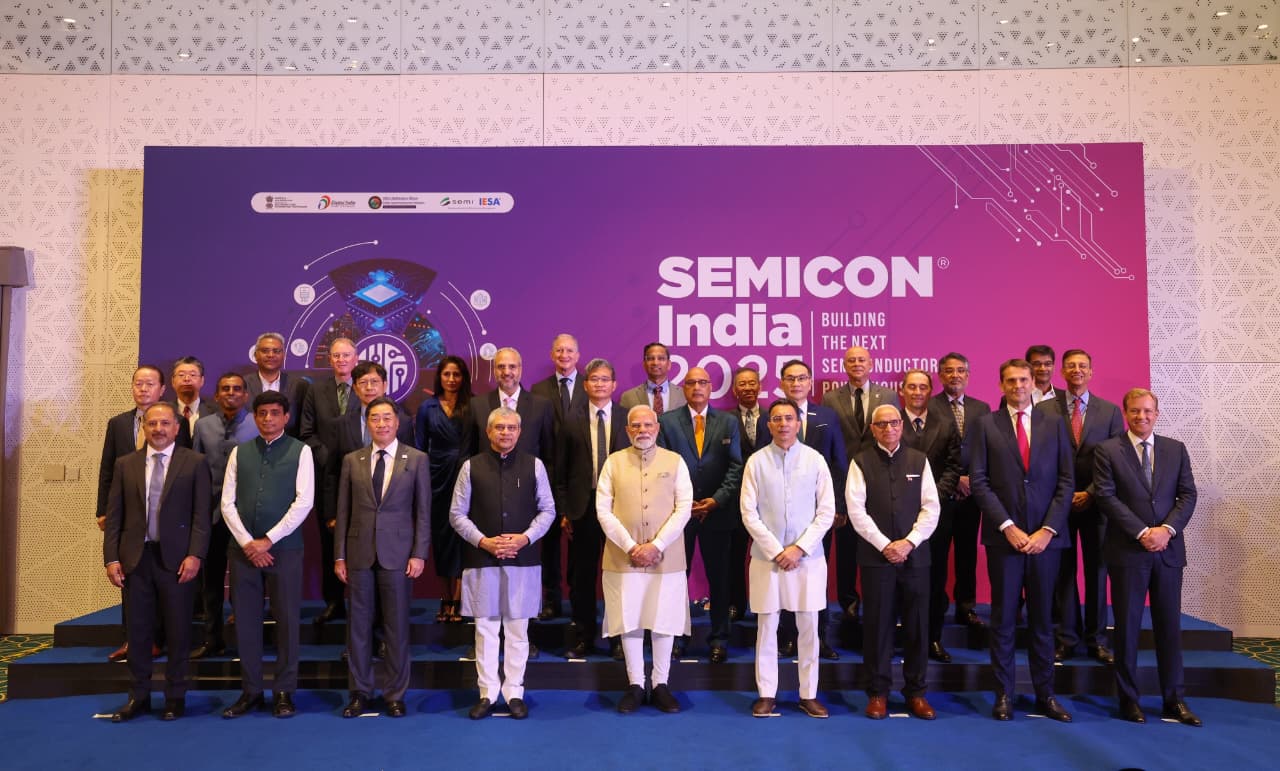
“The World Trusts India, The World Believes in India, And the World Is Ready to Build the Semiconductor Future with India.”
On September 2, 2025, Prime Minister Modi inaugurated Semicon India–2025 at Yashobhoomi, New Delhi, an event aimed at boosting India’s semiconductor ecosystem. The event brought together more than 20,750 participants, including over 2,500 delegates from at least 48 countries, over 150 speakers, and more than 350 exhibitors.
Chief Ministers, including Rekha Gupta (Delhi), Mohan Charan Majhi (Odisha), Union Ministers Ashwini Vaishnaw, Minister of State Jitin Prasada, SEMI President Ajit Manocha, and CEOs from around the industry joined the waves with thousands of enthusiastic entrepreneurs and young students in attendance.
In his speech, he noted that India returned from the first quarter of the financial year with a remarkable GDP growth of 7.8%, outperforming global expectations and seeing rapid growth in manufacturing, services, agriculture, and construction. India is now advancing toward becoming the world’s third-largest economy.
Modi called semiconductors “digital diamonds,” asserting that while oil shaped the past century, chips now held the mantle for transformative global power. The present global semiconductor market is around $600 billion; expectations are that it will exceed $1 trillion in the coming years, which is a great opportunity for India to secure a significant share.
India’s semiconductor mission began in 2021, with its first plant approved by 2023, followed by more in 2024, and five additional projects in 2025. A total of ten projects is now on the way, backed by investments exceeding $18 billion (over ₹1.5 lakh crore).
To facilitate speedier progress, the government has introduced the National Single Window System, which strives to streamline approvals among the Centre and State agencies without having to struggle through bureaucratic delays.
Coupled to this are semiconductor parks developing throughout the country under a plug-and-play infrastructure model offering land, power, connectivity, and skilled labor, combined with incentives like PLI schemes and Design Linked Grants that are drawing in big investments.
Pilot production is already underway: CG Power’s facility started operations on August 28, and Kaynes’ pilot plant is nearing launch. Test chips from Micron and Tata are also in production. Commerce-level chip manufacturing is expected to begin before the end of 2025
Prime Minister Modi said that India is developing the whole semiconductor ecosystem, including designing, manufacturing, and packaging with high-tech devices. New design centers in Noida and Bengaluru are developing advanced chips housing billions of transistors, preparing to power futuristic technologies.
Quite evidently, with the critical minerals grasp, the government has initiated the National Critical Mineral Mission, which will ensure domestic access to rare minerals that are critical for the manufacturing of semiconductors.
Modi expressed the view that India contributes about 20% of all design talent in semiconductors in the world: “We,” he said, “have a huge intellectual force in youth.” Thus, he calls upon startups and MSMEs to play an important role through such schemes as the newly launched under Anusandhan National Research Fund (attended by Design Linked Incentives and Chips-to-Startup).
He also encouraged states to engage in healthy competition, with specific policies and infrastructure focus for semiconductors that improved local investment climates. In keeping with its motto of Reform, Perform, Transform, the government is pursuing next-generation reforms in line with its semiconductor mission, clearly indicating that the policies they create are expected to focus on long-term commitment, as opposed to short-term signals for temporary changes.
India as a Semiconductor Hub
On September 3, 2025, Prime Minister Modi took to platform x (formerly Twitter) to share an article written by Union Minister Ashwini Vaishnaw on India’s journey to becoming a world power in semiconductors.