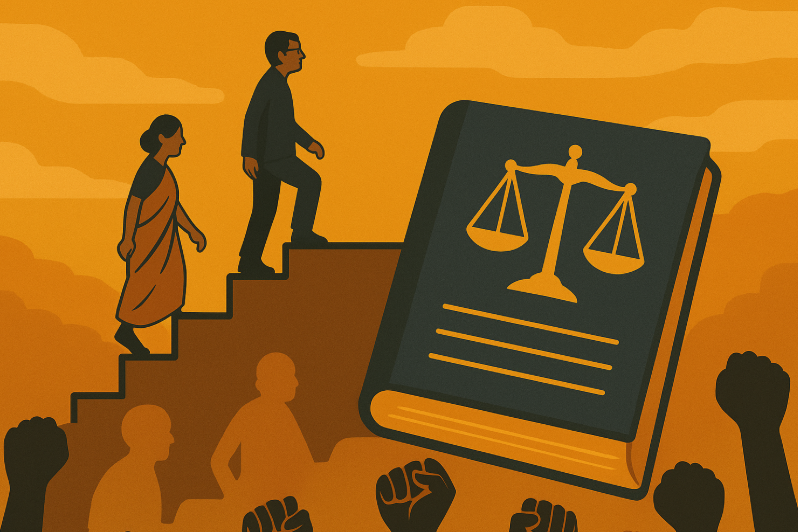
The Indian constitution contains caste-based reservation as an official instrument to achieve social justice, which remains highly controversial. The centuries-old caste system, which historically excluded numerous societal groups, led to reservations as a legal mechanism to secure equal representation and fair opportunities for those who lacked access to education and employment and political involvement.
The system first took shape under colonial rule when Shahu Maharaj created educational and employment reservations for Kolhapur’s backwards classes in 1902. The British government launched the Communal Award in 1932 to create distinct electorates for depressed classes, which led to the Poona Pact between Dr. B.R. Ambedkar and Mahatma Gandhi.
As the Constitution Drafting Committee chair, Dr. Ambedkar obtained legal measures to promote Scheduled Castes (SCs) and Scheduled Tribes (STs) along with Other Backwards Classes (OBCs). Articles 15(4) and 15(5), and 16(4) of the Indian Constitution mandate educational and employment reservations for socially and educationally backwards classes, while Article 46 allows States to implement actions which promote the educational and economic welfare of these groups.
The First Amendment Act, 1951, established the legitimacy of special provisions for backwards classes through Article 15(4). Through important judgments, the Supreme Court has established pivotal regulations regarding reservation law. The Supreme Court decided in 1962 that backwardness for reservation purposes needs social and educational aspects and that reservation capacity must stay below 50%.
The Indra Sawhney vs Union of India case in 1992, known as the Mandal case, confirmed the 27% reservation for OBCs while establishing that the total reservation percentage must remain under 50% except for exceptional situations. The ‘creamy layer’ of economically advanced OBC members became ineligible for reservation benefits through this decision, which clarified that reservation serves multiple purposes beyond caste considerations.
The concept of ‘creamy layer’ emerged to stop system abuses before becoming a recognised rule for OBCs, but not SCs and STs, because they experienced caste discrimination regardless of their financial situation. The Court established in Jarnail Singh vs Lachhmi Narain Gupta (2018) that the ‘creamy layer’ rule should affect SC/ST promotions, thus weakening previous judicial decisions.
The Supreme Court reaffirmed the requirement of concrete data to support reservation promotion cases in M. Nagaraj vs Union of India during 2006, thus maintaining judicial oversight of reservation policies.
The 103rd Constitutional Amendment of 2019 brought a major legal change by establishing a 10% reservation for Economically Weaker Sections (EWS) from the general category, which exists independently from caste-based reservations. The Supreme Court supported economic-based affirmative action in its 2022 ruling of Janhit Abhiyan vs Union of India, thus validating economic criteria for reservations while creating new discussions about caste versus class foundations of backwardness.
The constitutional legality of caste-based reservation does not end the ongoing disputes over this system. The proponents of caste-based reservations maintain that the caste system still influences how people access opportunities and obtain representation in contemporary India.
Supporters of caste-based reservation identify the insufficient representation of SC/ST/OBCs in high-level institutions and judicial bodies and private sector organisations, and top-level government administration. Critics of the system typically express their worries about discrimination against meritorious candidates and political exploitation, as well as the system of reverse discrimination.
Demands from various communities, including Marathas in Maharashtra and Patels in Gujarat and Jats in Haryana, continue to test the boundaries and restrictions of reservation policies. The Supreme Court overturned the Maratha reservation case (Jaishri Laxmanrao Patil vs State of Maharashtra, 2021) while confirming that the 50% reservation limit requires exceptional conditions for any breach.
Various states have attempted to extend reservation limits by using the argument of exceptional social and educational backwardness.
The reservation policy faces critical questions about its future direction: Should caste serve as the only qualification or should economic and educational deprivation receive equal consideration? Does the reservation system need periodic assessment to stop its transformation into permanent entitlement? Should reservation policies apply to private sector organisations when government job numbers continue to decline and privatization expands? Should the focus of reservation policies shift toward capacity-building through scholarships and skill development programs and specific outreach initiatives rather than maintaining quota systems?
The solution might emerge from developing an inclusive hybrid affirmative action system which incorporates caste alongside class and gender and regional, and disability-based considerations.
Caste-based inequalities still shape people’s lives for a range of reasons the deep implications of caste isolation (or at least that acknowledgment, for those who claim it’s not an issue anymore), partisan dissonance, and unequal rates of development – we know that according to the India Human Development Survey or IHDS, Dalits and adivasis still trail, behind on literacy, income, land ownership and basic services. Social discrimination is rampant, tacit and overt, whether that is: manual scavenging, residential segregation, getting kicked out of school, or discriminatory hiring processes.
In that regard, any change to the reservation policy will be slow, with a lot of evidence to support it. Political will, judicial clarity, and social engagement will be required to avoid this becoming another opportunity for people in the majoritarian and polarised discourse to be pulled down again and get affirmative action once again to be firmly restored as a backup to and amendment of its true constitutional purpose as justice, equality, and fraternity.
In short, caste-based reservations are not only legal provisions, only they are the very living expression of India’s promise to rectify historical injustices and create an equitable society. But, as with all instruments, they must adapt to the march of time. A sane, data-driven, and inclusive policy that serves social justice as top priority while promoting merit and innovation will be able to moderate the conflicting goals of equity and excellence. The destiny of the reservation has to be less numerical and more transformative.