Once at the receiving end of caste oppression and generational marginalisation, Bengal’s backwards communities are now at the bullseye of an explosive political showdown. As the 2026 Assembly elections inch closer, a storm is brewing, not just in political corridors but in courtrooms and classrooms alike.
In a noteworthy development, the Supreme Court of India overturned the Calcutta High Court’s May 2024 judgment, by approving the revised OBC list of Bengal and restoring the 17% reservation for 140 communities of the state. It also granted the state a 3-month duration until July to conduct extensive research and surveys on demographics, contributing to accurate data.
On June 10, Chief Minister Mamata Banerjee tabled the revised OBC report in the legislative assembly, marking a fresh chapter in Bengal’s fraught caste discourse.
Unveiling the New OBC List:
| Category | Reservation | No. of Groups | No. of Muslims | Muslims % |
| A [more Backwards] | 10% | 49 communities | 36 | 73.4 % |
| B [Backwards] | 7% | 91 communities | 44 | 48.3 % |
| Total | 17% | 140 | 80 | 57.1 % |
While the government has allocated 10% reservation to OBC-A and 7% to OBC-B, the percentages may shift as 50 additional groups remain under evaluation, including Sadgop and Nepali Brahmin, now awaiting fresh socio-economic surveys.
| Category | Reservation | No. of Groups | No. of Non-Muslims | Non-Muslims % |
| A [more Backwards] | 10% | 49 communities | 13 | 26.6 % |
| B [Backwards] | 7% | 91 communities | 47 | 51.7 % |
| Total | 17% | 140 | 60 | 42.9 % |
Following the Supreme Court clearance, educational institutions such as Jadavpur University and Calcutta University will resume OBC-category admissions, which had earlier been paused.

The Judicial Footprints: Game of Numbers
The seed of this ‘OBC status’ tree was sown in 2011, when the first PIL was filed in the high court challenging the authenticity of the 42 OBC classes, calling it religion-inclusive. An additional 34 Muslim groups were tagged as OBC after the TMC formed the state government in 2011. These 34 OBC classes were challenged in court at that time.
In March 2013, the West Bengal Backward Classes Act of 2012 was officially announced, introducing the OBC-A and OBC-B categories as well as 77 new OBC classes, for which two PILs were subsequently filed.
Looking back at the past, the 1992 Indra Sawhney judgment directed that every state shall have their own commission to inspect the eligibility of classes that shall be accounted in the OBC lists.
On May 22, 2024, the Calcutta High Court struck down 77 Muslim groups out of 133 total groups of the old OBC list, on the grounds of insufficient survey methodology and underrepresentation of religious groups. This move affected approximately 5 lakh OBC certificates and recruitment in state educational institutions.
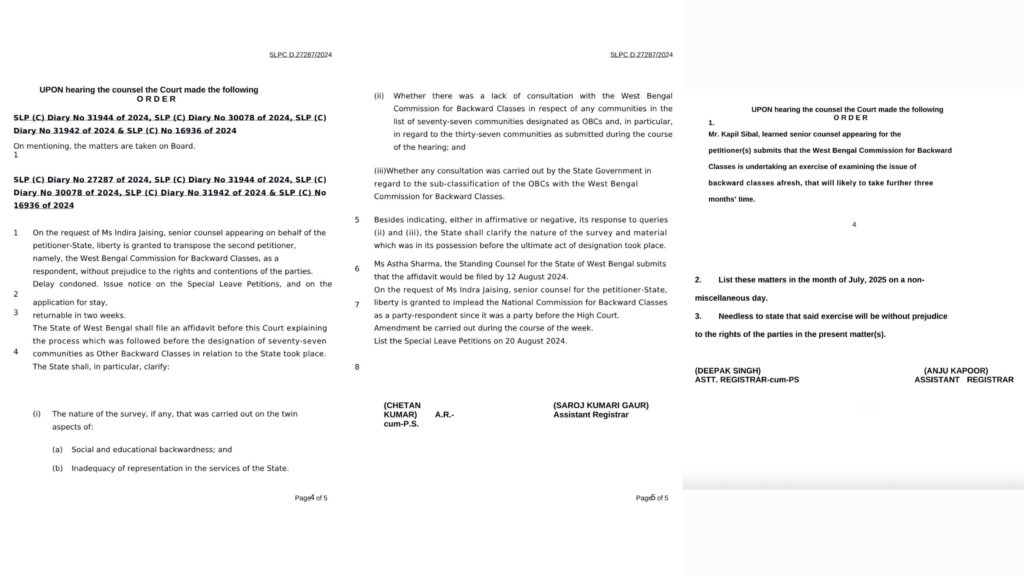
Consequently, the State of West Bengal appealed to the Supreme Court, filing a Special Leave Petition (SLP), Diary No. 27287/2024, titled “Amal Chandra Das vs State of West Bengal & Ors.
The Bengal state government established a new Backward Classes Welfare Commission, chaired by Justice Ashim Kumar Banerjee. Cultural Research Institute partnered with it, which is a scientific and technical wing of the Backward Classes Welfare Department in the Bengal government. Another independent body, the Bureau of Applied Economics & Statistics, also collaborated for data collection in the socio-economic survey.
The June 2016 ‘Kotal Muslim survey‘ reveals significant irregularities in the process, emphasising the concerning speed with which certain Muslim communities were added to the OBC list.
Court verdict spilled into Politics:
The leader of the opposition, Adhikari, claimed that the assembly was called out by the speaker, Biman Banerjee, before the opposition could put their stance. Consequently, the members of the saffron party protested outside the assembly. In a Sandeshkhali event, Suvendu Adhikari advocated for Hindu reservations, claiming that the OBC report has been for the appeasement of the Muslim vote bank.
Changing the definition of OBC (Other Backward Classes) to ‘One-Sided Beneficiary Classes‘, Suvendu Adhikari accused the TMC state government of depriving Hindus and other minorities. The BJP leader of the West Bengal unit further added that the OBC list is based on religion.
The BJP leader Amit Malviya alleged that the OBC list is formulated to support Rohingyas and Bangladeshi Muslims. Hitting out at the No. 17 of the OBC-B list, he posted ‘conversion (to Christianity) from Hinduism is being rewarded with OBC status and lifelong reservation benefits’ on social media.
NCBC raise eyebrows:
The National Commission for Backward Classes (NCBC) has requested complete survey reports and commission recommendations within a three-day time frame. NCBC Chairman, Hansraj Gangaram Ahir, reports that the state has failed to provide previously requested information. The NCBC investigation and any subsequent Supreme Court review are likely to generate further discussion.
“Is the revised OBC list in Bengal a genuine attempt to uplift backward communities or is it a politically motivated before the 2026 elections?