Maternity is not just a benefit—it’s a right.
The Supreme Court states that Maternity leave is a basic right: The story of K.Umadevi.
BACKGROUND OF THE CASE.
K. Umadevi, who’s a government teacher in Tamil Nadu, joined the public service in December 2012. Before joining this, she was married and had two children in (2007&2012). She divorced her first husband and then remarried in September 2018.
For Umadevi’s third child, born from her 2nd marriage, she applied for Maternity leave in August 2021. The school education department rejected her request saying under Fundamental Rule 101(a) of the Tamil Nadu Government rules , Maternity leave cannot be given to a women if she has two or more surviving children.
Umadevi then decided to challenge this decision in the Madras High Court.
A Single Judge Bench of the High Court ruled in her favor, stating that she should be granted maternity leave, since her earlier two children were not in her custody. But the Division Bench of the High Court later reversed this decision, saying she was not eligible for leave due to having more than two children.
She was very unhappy with this hearing and decided to approach the Supreme Court.
THE SUPREME COURT’S OBSERVATION.
This case was heard by Justices A.S. Oka. and Ujjal Bhuyan. Some very important observations were made by the court.
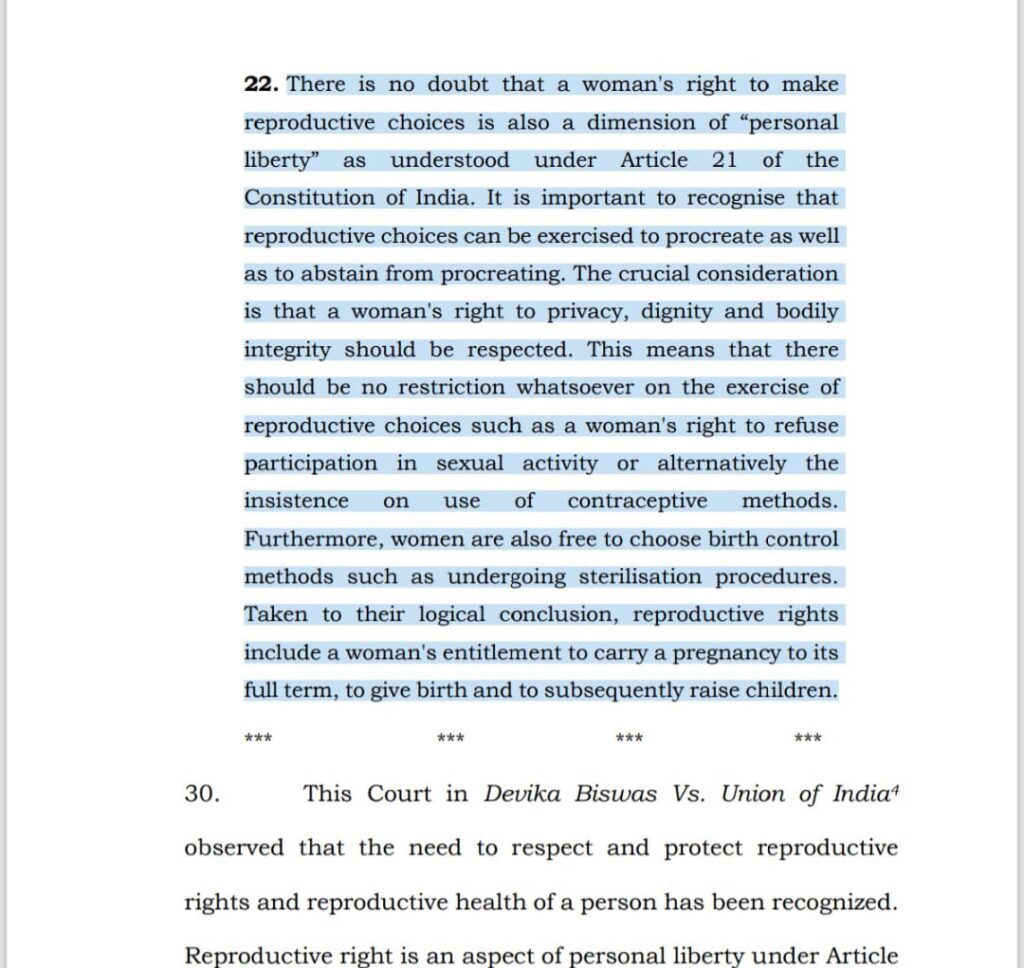
The court stated that maternity leave is not just a benefit given to a women, its a part of women’s right to live with dignity, which comes under article 21(Right to life and personal liberty) under the Indian Constitution. It also includes right to health, reproductive choice, motherhood and privacy.
The rule says maternity leave is not allowed if a woman has two or more surviving children. But the Court said this must be read in context. Since Umadevi’s first two children were not living with her (they were with the first husband), it would be unfair to count them against her.
THE MATERNITY BENEFIT ACT IS CLEAR
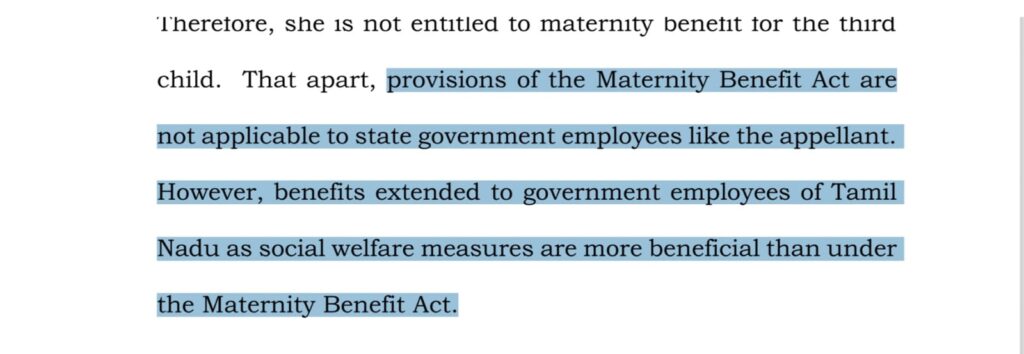
The Maternity Benefit Act of 1961 is a national law which allows maternity leave to all working women, even if they have more then two children. The only difference is (duration up to 26 weeks for first two children, and 12 weeks after that).
Even if the government wants to control the population, the Court stated that a woman’s personal rights must always come first. Rules should not be made in a way that denies basic rights to working women.
The court also referred to some early cases s well. like the Deepika Singh v. CAT (2023) and Suchita Srivastava v. Chandigarh Administration (2009) where it was stated that reproductive choices are a part of a women’s Fundamental Rights.
THE COURT’S JUDGEMENT.
The Supreme Court allowed K. Umadevi’s appeal and restored the earlier decision of the Single Judge of the Madras High Court. It said:
- The rejection of maternity leave was unconstitutional.
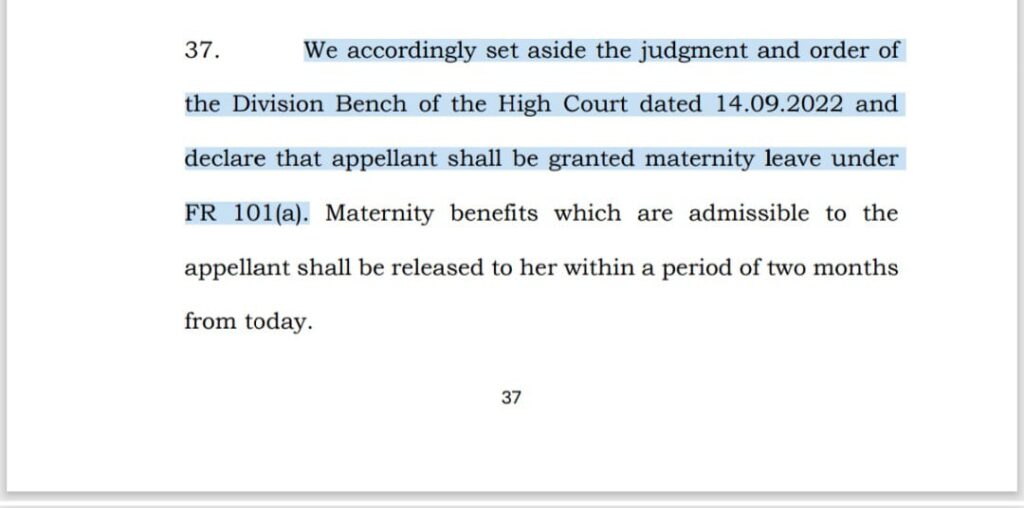
- The State Government must grant her maternity leave and release all related benefits within two months from the date of judgment (23 May 2025).
This judgement gives us a strong message that women’s reproductive rights must be protected and respected especially by the departments of government and employers. The judgement also ensures that single mothers, remarried women, or women dealing with family situations are not be treated unfairly just because of the strict government rules.