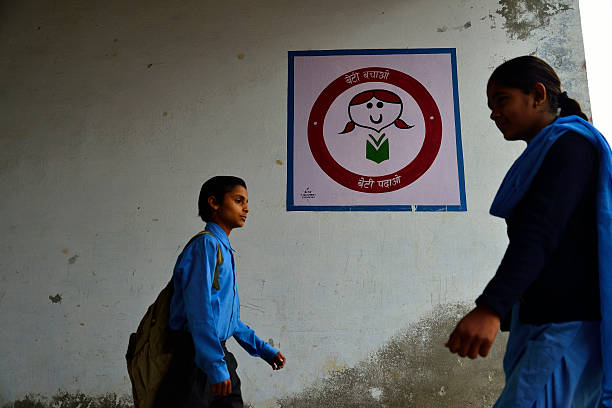
The scheme launched by Prime Minister Narendra Modi, Beti Bachao Beti Padhao (BBBP), is a combined task from the Ministries of Women and Child Development, the Department for Health and Family Welfare, and the Education Department. It includes various communities, the district officials, and workers from the frontline area to assure safety and empower India’s girl children.
The Beti Bachao, Beti Padhao Scheme works to tackle the dropping sex ratio of children, which is also called Child Sex Ratio (CSR), that is calculated as girls per one thousand boys who are between the age group of 0 to 6 years old. It helps to promote education for girls and safety for their livelihood. This scheme was launched to counter biased issues towards gender.
The awareness is propagated through various campaigns, strict laws, and incentives of financial aid, such as the Sukanya Samriddhi Yojana. A data collection that has been done recently showcases the progress output, as it mentions that the Sex Ratio at the time of birth (SRB) has risen from 918 in 2014-15 to 930 in 2023-24, which tells us there is a 12-point improvement in it.
The secondary education for girls enrollment in it has grown from 75.51% to 78% in the same time frame, and the deliveries in the institutions have increased from 61% to 97.3%, which shows childbirths have led to safer instances. In the north side of Gujarat, around 4.5 lakhs of Sukanya Samriddhi Yojana accounts were created, and 487 villages were recognised as Sukanya Samriddhi Grams, which were able to secure a financially improved future for the girls.
This scheme, Beti Bachao Beti Padhao, was launched on 20th January 2015, at the Panipat district in Haryana. In the ongoing year 2025, it has achieved its 10th-year anniversary, which celebrates a decade-long year of efforts for gender equality. From the year 2021, this scheme has been combined into a sort of mission named Shakti, which focuses on uplifting the safety of women and their empowerment.
As per the recent updates, which have an inclusion of district-level meetings that have taken place in 2025, such as one of the meetings that happened in the Puri district of Odisha on 22nd July recently, to build up the coordination among them.
The Beti Bachao Beti Padhao Scheme is operational in all the districts in India. At first, it had a target of 100 such districts with a low rate of CSR in the year 2014-15, which increased up to 161 by the year 2016, and currently it’s spread out nationwide. The state of Haryana is now at a prime focus, which has seen an improvement in SRB to the 910 position in the year 2024, as it had dropped from 923 in the year back in 2019, which showcased very unbalanced development.
In the state of Tamil Nadu, districts such as Namakkal and Thiruvannamalai have achieved national awards in the year 2019 for a proper community exchange. The other Indian states, such as Odisha and Goa, have also reported improvements in SRB data to 933 and 977 positions, respectively, by the year 2023-24.
The CSR rate of India dropped to 918 in the year 2011, which showcased an internally deep-rooted bias towards gender identity that included the foeticide of females, the choice of sons over daughters, and the neglect of girl children for health and education. The types of norms in the culture, like the dowry custom, the practice of inheritance, and the issue of discrimination.
The Beti Bachao Beti Padhao Scheme is motivated to change the mindsets, to remove sex-selective biased abortions, and to ensure that girls survive and are empowered ahead. This scheme has shown both pre-birth discrimination and after-birth partialities in the aspects of education and nutrition.
The Scheme Beti Bachao Beti Padhao tries to involve strategies in multiple sectors that work on applying laws against selective sex abortions, which go along with campaigns such as “Selfie with Daughter,” as it propagates schemes related to finance, such as Sukanya Samriddhi Yojana, which gives 8.2% tax-free interest.
There are the efforts of the community that involve plays on streets, oath-taking programs, and programs related to awareness spreading, like the street plays of Pithoragarh, which reach around 700 students and the personnel from the army.
In the state of Haryana, some implementations, such as sanitary napkin machines for vending them in places like schools and women’s police stations, and the Aapki Beti Hamari Beti Scheme, resulted in change, which is about an investment of Rs. 21,000 for the girls from SC and BPL backgrounds.
In Tamil Nadu, an engagement of communities achieved a position of recognition; in Odisha state, there was a conduct of training for the workers at the frontline, and along with the media propagation, it helped to boost the awareness at a larger level around the state.
But still there lie some issues and challenges, as we can see that in the year 2021, according to a report from Loksabha, it was noted that around 78.91% of this scheme’s allocated money under this scheme was used on advertisements, which created concerns about its implementation.
There is a decline of SRB in some regions, and the enforcement of laws is also very weak, which highlights the need for efforts that are sustainable to implement ahead.
As we can see, in spite of progress, the issues of gender remain complicated. The scheme Beti Bachao Beti Padhao, which has had success rates in states such as Haryana, Tamil Nadu, and Goa, highlights a sort of commitment that has led to an improvement in the SRB and the metrics for educational aspects. As there are drawbacks in some particular regions, and also the cultural issues have created a need for stronger action on this.
This scheme has been aligned with the Mission Shakti and the programs of initiatives, such as the Lakhpati Didi, that have empowered around 1 crore women financially as well, as it aligns with India’s aim for the equality of gender under the development of sustainable motives. Through the nourishment of the community, inclusivity, the enforcement of laws, and the propagation of educational aspects.
This scheme, Beti Bachao Beti Padhao, has aimed to ensure that each of the girl children is given greater value equally among the genders. The commitment that is sustainable from the side of society and government is very necessary to achieve progressive and equitable future aspirations for India’s daughters.