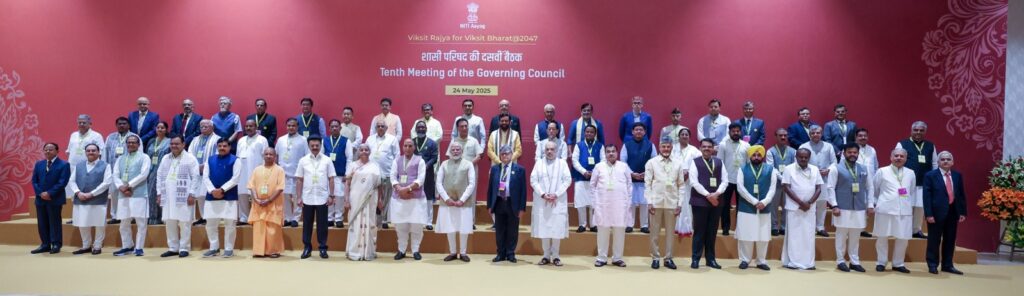
Prime Minister Narendra Modi, chairing the 10th Governing Council Meeting of NITI Aayog at Bharat Mandapam in New Delhi, called upon all states to develop at least one world-class tourist destination under the theme “One State: One Global Destination.” He emphasized that this initiative would not only boost tourism but also catalyze the development of nearby cities.
The meeting, attended by Chief Ministers, Lieutenant Governors of Union Territories, Union Ministers, and key officials of NITI Aayog, revolved around the central theme “Viksit Rajya for Viksit Bharat @2047” — a vision to transform India into a fully developed nation by its centenary of independence.
Tourism, Urbanization, and Investment in Focus
PM Modi noted that the G20 Summit had significantly enhanced India’s global tourism profile and encouraged states to capitalize on this momentum. He suggested that developing 25–30 international-standard destinations across India could position the country as a global tourism hub.
Acknowledging the rapid pace of urbanization, he called for the development of “future-ready cities” driven by sustainability, innovation, and economic growth. A new ₹1 lakh crore Urban Challenge Fund is being established to support urban development and seed innovation, particularly in Tier-2 and Tier-3 cities.
Skilling, Manufacturing, and Green Energy
Emphasizing the importance of skilling for the future, the Prime Minister urged states to align with the National Education Policy (NEP) and invest in skills related to AI, semiconductors, and green technologies. He highlighted a ₹60,000 crore skilling initiative launched by the Centre to support this goal.
States were also encouraged to leverage the recently signed trade agreements with countries like the UAE, UK, and Australia. PM Modi emphasized India’s manufacturing potential and urged states to play an active role in attracting global investment.
Women’s Empowerment and Civil Preparedness
Calling Nari Shakti the backbone of the nation’s progress, PM Modi advocated for policy reforms to increase women’s participation in the workforce. He urged both the public and private sectors to create inclusive and enabling environments for working women.
Touching on civil preparedness, he asked states to institutionalize civil defence mechanisms and treat initiatives like Operation Sindoor as long-term strategies rather than one-off events.
Agriculture, Health and Water Management
The Prime Minister outlined the Viksit Krishi Sankalp Abhiyan, which will see around 2,500 agricultural scientists engaging directly with villages to promote sustainable farming practices and crop diversification.
In health, Modi stressed strengthening telemedicine infrastructure, expanding services like E-Sanjeevani, and ensuring readiness for any potential COVID-19 resurgence. He also highlighted the importance of water management through intra-state river-linking, citing Bihar’s Kosi-Mochi grid as a successful example.
Cooperative Federalism and Shared Vision
Leaders from 24 states and 7 UTs participated in the meeting, sharing successful practices and outlining their vision for 2047. The Prime Minister commended the collaborative spirit and emphasized that Viksit Bharat is not just a government initiative but the collective aspiration of 140 crore Indians.
He directed NITI Aayog to thoroughly study the suggestions from states to align national and regional development goals. Concluding the meeting, PM Modi reaffirmed that cooperative federalism is key to achieving the goal of a developed India well before 2047.