“We do not have the fantasy of competing with the economically advanced nations in the exploration of the Moon or the planets or manned space flight. But we are convinced that if we are to play a meaningful role nationally and in the community of nations, we must be second to none in the application of advanced technologies to the real problems of man and society.” — Dr. Vikram Sarabhai
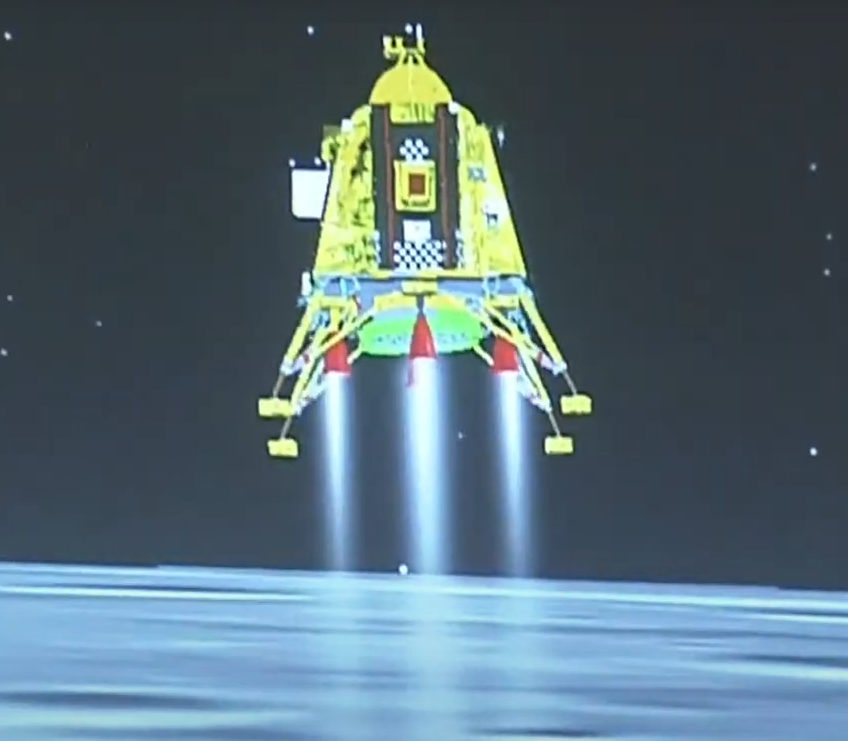
India pauses on August 23 to celebrate its National Space Day. This day is not just a mark on the calendar; it is a tribute to the nation’s spirit of exploration, resilience, and belief in science. This day remembers the historic moment of Chandrayaan-3’s soft landing on the Moon’s south pole on August 23, 2023, marking India as the first nation in history to reach that uncharted terrain. Prime Minister Narendra Modi, calling it a historic victory for every Indian, declared the day as National Space Day to honour the achievement and the decades of India’s space story from bullock carts in Thumba to the south pole of the Moon. By 2025, the day has grown into something larger. At Bharat Mandapam in New Delhi, ISRO unveiled the model of the Bharatiya Antariksh Station (BAS), India’s own dream of a permanent outpost in space. If Chandrayaan-3 proved India could reach where no one else had, BAS declares that India is ready to live and work in space, shaping humanity’s shared future.
Steps behind the success of Chandrayaan-3
On 15th August 1969, as India marked its 22 year of independence, the government established the Indian National Committee for Space Research (INCOSPAR) by recommendations of Dr. Vikram Sarabhai and later renamed it as the Indian Space Research Organisation (ISRO). Sarabhai, often called the father of India’s space program, believed space was not about prestige but about people.
“We must be second to none,” he said, not in building grand rockets to impress the world, but in using satellites to help a farmer predict his harvest, to bring education to villages, and to heal patients far from hospitals.
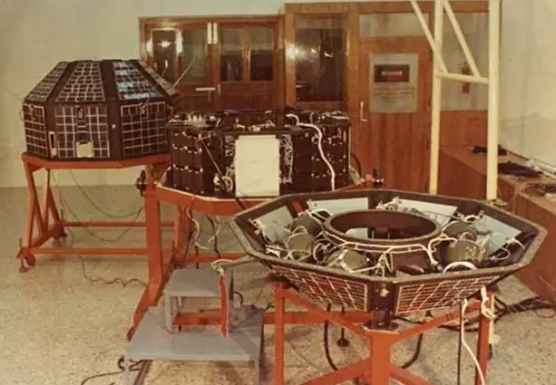
The beginning stage of ISRO had its difficulties; ISRO’s first launch site in Thumba, Kerala, was nothing more than an old church, with rocket parts carried on bicycles and bullock carts. On April 19, 1975, India’s first satellite, Aryabhata, was built by ISRO but had to be launched with help from the Soviet Union’s Kosmos-3M rocket from Kapustin Yar.
It was a proud day, but it reminded India of its dependence on other agencies. Then came the year 1979, when ISRO tried to launch its first satellite with its own rocket, the SLV-3. The mission failed the satellite plunged into the Bay of Bengal.
Newspapers mocked, critics questioned, but Dr. A.P.J. Abdul Kalam, then project director, encouraged the team to rise again. A year later, in 1980, the same SLV-3 successfully placed RS-1 into orbit, and then India became the seventh nation on Earth capable of launching satellites on its own. That resilience falling once but soaring higher the next time became ISRO’s heartbeat.
Through the 1990s, ISRO built advanced rockets. The PSLV (Polar Satellite Launch Vehicle) became a workhorse, known for reliability and low cost. Its record was stunning in 2017, ISRO launched 104 satellites in a single mission, a world record. Nations that once mocked India now lined up to book their satellites on Indian rockets. From being called a “poor man’s space agency,” ISRO had become the go-to agency for affordable access to space.
But rockets were just the beginning of India’s space dream. In 2008, ISRO launched Chandrayaan-1, which carried India’s flag to the Moon. The mission discovered something that changed the perspective of space science forever: the discovery of the presence of water molecules on the lunar surface. With that discovery, the world turned to India not just as a participant in space but as a pathbreaker.
Soon after Mission Chandrayaan-1, ISRO worked on a mission to reach planet Mars. The Mars Orbiter Mission (Mangalyaan), launched in 2013, stunned the world by entering Mars orbit on the very first attempt in 2014, marking India as the 1st country.
Even more remarkable is that the mission cost was just ₹450 crore (about $74 million), which was less than the budget of a Hollywood film. A reporter once joked that it was cheaper to go to Mars with ISRO than to make a space movie about it. The success made every Indian walk with pride.
In these space missions, there were heartbreaks too. In 2019, the lander of Chandrayaan-2 crashed during its soft landing. Millions watched in silence as scientists’ faces fell. In that unforgettable moment, Prime Minister Modi embraced a tearful K. Sivan, then ISRO’s chairman, showing the world that science is not just about machines and numbers but about human hearts: the courage to attempt, the pain of setbacks, and the undying will to rise again.
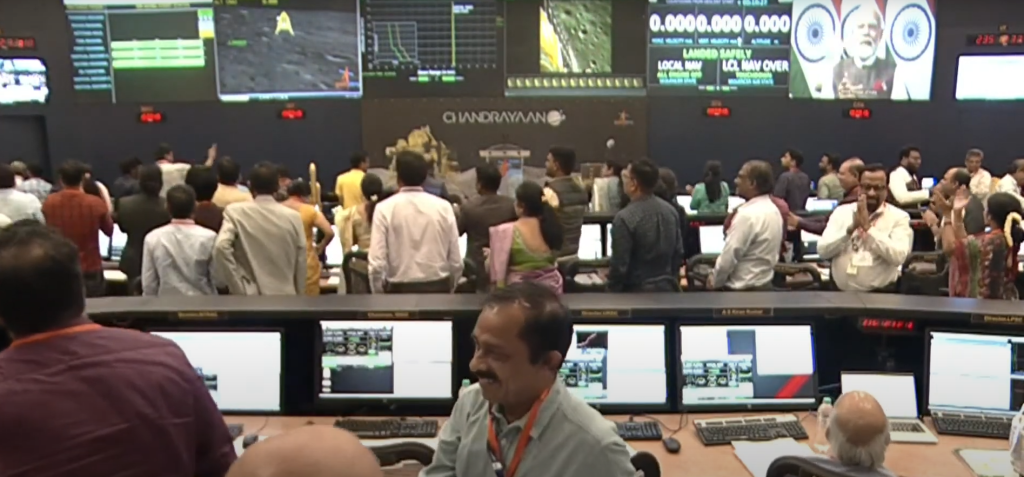
That willpower resulted in Chandrayaan-3 and its historic win. On 23rd August 2023, the lander made a soft landing on the Moon’s south pole, a place no space agency had reached before. Happiness erupted not just in ISRO but across every Indian home. Children waved flags, elderly citizens wept, and the world saluted. India had not just landed on the Moon; it had landed in history.
ISRO did not stop there; they launched Aditya-L1 in 2023, which is India’s first mission to study the Sun. It watches solar storms and flares, helping protect satellites and power systems on Earth. With this mission, India’s ISRO added solar science to its growing portfolio of planetary missions.
Now, in 2025, ISRO is preparing for a bigger game, i.e., Gaganyaan, India’s first human spaceflight program. Under the leadership of current chairman V. Narayanan, the organisation is building the systems that will carry Indian astronauts into orbit. Dr. S. Somanath, ISRO’s ex-chairman, often says, “We must make ISRO a people’s organisation.”
The story of ISRO is not just about machines; it includes people. It is about scientists who worked late nights with limited resources and funds, women engineers who designed the navigation systems for Mangalyaan, and young students pursuing space as a career, not just a dream. It is about a nation’s image that was once mocked for carrying rocket parts on bullock carts, is now being praised for running one of the most efficient and visionary space programs in the world.
National Space Day is not just about successful rocket landings; it is about a nation that dreamt of its independence in space programs. From the quiet prayers at Thumba’s little church to the victory cheers when Chandrayaan-3 touched the Moon, India’s space journey is filled with a number of stories filled with hope, struggle, and joy. It is about scientists who never gave up, and the leaders who believed in vision over doubt, and a billion hearts that beat as one whenever our tricolour shines in space.
As India unlocks new dreams like the Bharatiya Antariksh Station, prepares to send its own astronauts into orbit, and looks toward the Sun, Mars, and beyond, one thing is clear: this journey belongs to all of us. It is not just ISRO’s story but the story of every farmer who trusted weather satellites, every student who looked up at the stars with wonder, and every citizen who feels pride when the world applauds India.
On this 23rd August, as we celebrate National Space Day, we celebrate not just Chandrayaan-3 but the spirit of a nation that turned impossibility into possibility. India is not just reaching for the stars; it is carrying its people, its dreams, and its future into the universe.
“No one can stop India from emerging as a great power. The strength of the nation lies in our ability to convert dreams into reality.” – Atal Bihari Vajpayee