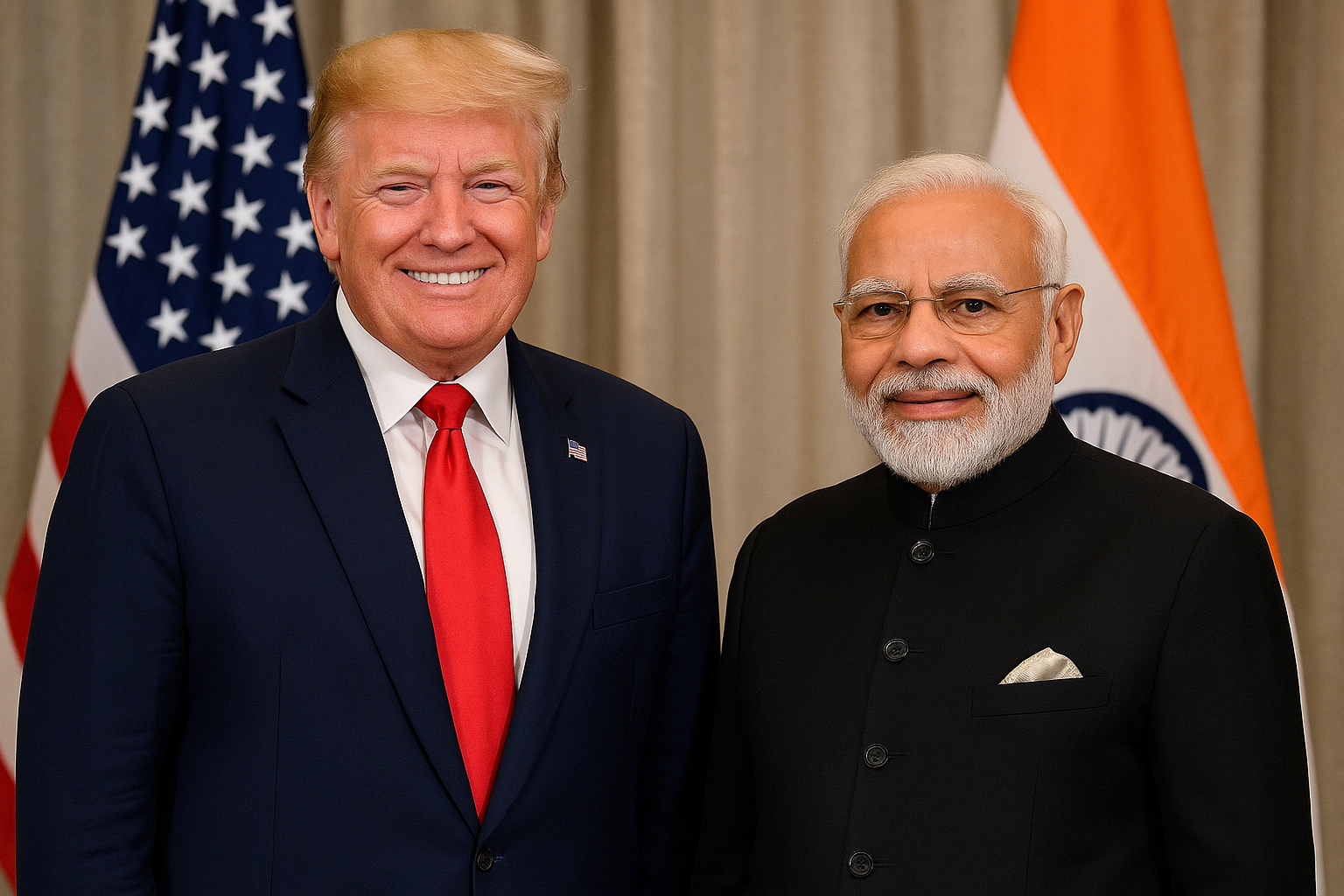
Trade negotiations between India and the United States are set to resume, President Donald Trump announced this week, as he and Prime Minister Narendra Modi exchanged warm messages on social media. The two leaders are expected to speak directly in the coming weeks, signaling an attempt to reset a relationship that has been under pressure in recent months.
The talks, aimed at reviving discussions on a Free Trade Agreement (FTA), had stalled after the U.S. imposed steep tariffs, first 25% and later 50% on Indian goods. The move was linked to India’s continued energy purchases from Russia, which Washington argued indirectly funded the Ukraine war. New Delhi has rejected such claims, insisting its oil imports are a sovereign and market-driven decision.
Even so, Indian refiners, who imported nearly two million barrels per day of Russian oil in August, have avoided placing new orders this September. Officials say this pause reflects caution while negotiations are underway, though no formal restrictions have been issued by the government.
In recent weeks, both governments have stepped up behind-the-scenes diplomacy. Meanwhile, Commerce and Industry Minister Piyush Goyal, addressing an industry event, underlined that no business partnership could remain “one-sided.”
Indian chief negotiator Rajesh Agarwal is scheduled to lead a delegation to Washington next week, marking the most concrete step in months toward resuming formal discussions.
Why the Resumption Matters
The benefits of these trade talks could be significant for both nations.
For India, this resumption could lead to:
- Lower tariffs on exports: Giving greater access to the U.S. market for textiles, pharmaceuticals, IT services, and manufactured goods, sectors that are crucial for job creation.
- Technology transfer: Closer cooperation with U.S. companies in defense, aerospace, and clean energy could accelerate India’s modernization drive, hence improving the tech side of India.
For the United States, the advantages are:
- Agriculture and dairy access: The US has always wanted to be an integral part of the agriculture and dairy industry of India, which might give the former a way to analyze the industry.
- High-value exports: From aircraft and technology to energy equipment, the U.S. would gain entry into a fast-growing market.
- Strategic influence: Strengthened economic ties would help the US counterbalance China’s rise in Asia, consolidating India as a critical Indo-Pacific partner.
Trump, posting on Truth Social, said he looked forward to speaking with his “very good friend” Modi and predicted a “successful conclusion” for both nations. Modi, in turn, wrote that “India and the US are close friends and natural partners. I am confident that our trade negotiations will pave the way for unlocking the limitless potential of the India-US partnership.”
He added that both sides are working “to conclude these discussions at the earliest,” and expressed hope that the talks would help secure “a brighter, more prosperous future for both our people.”
This shift in tone marks a contrast from earlier months of sharp contrast, when Trump described the relationship as “totally one-sided” and questioned India’s oil policy. Modi’s reply sought to underline continuity in India–U.S. ties, stressing the natural partnership between the two democracies.
Uncertainty still lingers as Trump’s participation in the Quad summit in India later this year remains unconfirmed, with his Asia-Pacific schedule still under discussion. The FTA negotiations themselves face obstacles, particularly disagreements over agriculture and dairy access in India.
Yet, the diplomatic public stance from both leaders suggests an awareness that trust, not tariffs, must ultimately define the relationship. If the upcoming talks yield progress, the outcome could be more than economic; it would represent a reaffirmation of the India–U.S. partnership as a pillar of global stability.