Under China’s presidency, the 22nd Meeting of Ministers of Defense of the Member States of the Shanghai Cooperation Organization took place in Qingdao on June 26, 2025.
In a powerful address at the Shanghai Cooperation Organisation (SCO) Defence Ministers’ Meeting, Defence Minister Rajnath Singh called for a united and uncompromising global stance against terrorism, radicalisation, and the proliferation of weapons of mass destruction. Citing the growing trust deficit and regional insecurity, Singh emphasised that peace and prosperity cannot thrive where terror finds sanctuary.
SCO Secretary-General Nurlan Yermekbayev, Ularbek Sharsheev, the Director of the Executive Committee of the SCO Regional Anti-Terrorist Structure, and the leaders of the Organization’s member states’ defense agencies attended the event.
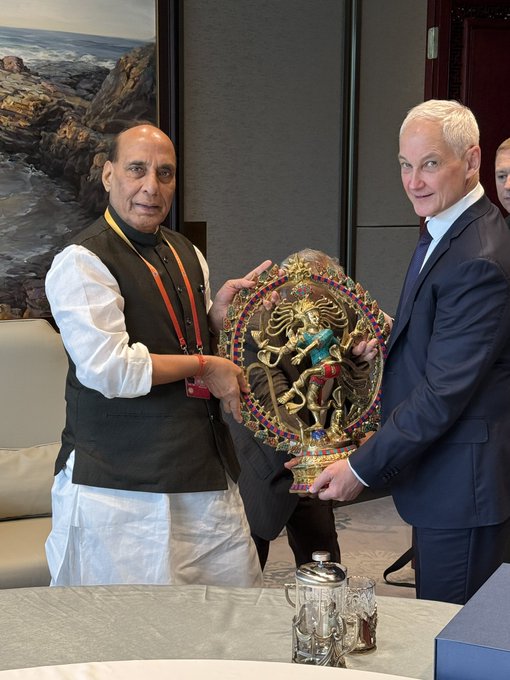
“Terror Has No Justification”: Singh’s Message to SCO Members
Addressing defence ministers from SCO member countries, including Russia, China, Pakistan, Iran, and Central Asian nations, Shri Rajnath Singh delivered a candid appeal for collective action. He stated that terrorism, extremism, and radicalisation were the root causes of the region’s instability.
“Peace and prosperity cannot co-exist with terrorism and the proliferation of WMDs in the hands of non-state actors,” Singh said. “It is imperative that those who sponsor and support terrorism must face consequences.”
His remarks appeared to be a direct rebuke to countries accused of sheltering terrorists and employing cross-border terrorism as a state strategy—an oblique reference to Pakistan, although no country was named explicitly.
Operation Sindoor: A Clear Stand Against Terror
Singh pointed to the April 22 terror attack in Pahalgam, Jammu & Kashmir, where 26 civilians, including a Nepali national, were killed. The attack, he said, was religiously motivated and claimed by The Resistance Front, a proxy of the UN-designated Lashkar-e-Taiba.
“India’s response through Operation Sindoor on May 7 was not just a military decision; it was an assertion of our right to self-defence,” Singh stated. “We have made it clear—epicentres of terrorism are no longer safe.”
India Refuses to Back Joint SCO Statement
The two-day meeting concluded without a joint statement—a rare outcome for such high-level multilateral meetings. India’s Ministry of External Affairs (MEA) later revealed that New Delhi did not support the final draft due to its failure to adequately address the issue of terrorism.
MEA spokesperson Randhir Jaiswal clarified, “India wanted concerns on terrorism to be reflected. However, one particular country objected, preventing a consensus.”
Highlighting the evolving nature of modern threats, Singh warned about the misuse of technology by terror outfits—from drone-enabled smuggling of arms and drugs to cyber warfare and hybrid tactics.
“These threats do not respect national boundaries. In our interconnected world, traditional borders are no longer the only lines of defence,” he warned, calling for increased cooperation through platforms like the SCO’s Regional Anti-Terrorist Structure (RATS).
India’s Vision: One Earth, One Family, One Future
Reaffirming India’s commitment to building a peaceful region, Singh urged SCO nations to embrace the principle of Vasudhaiva Kutumbakam—the idea that the whole world is one family. He cited India’s G20 motto, “One Earth, One Family, One Future,” as the foundation for international cooperation.
“Mutual understanding and mutual benefit must guide our way forward,” Singh said. “Only through inclusive, transparent, and collective effort can we overcome the complex challenges of our time.”
A Collective Stake in Regional Peace
Singh underscored India’s enduring support for stability in Afghanistan, stressing humanitarian aid, development cooperation, and capacity-building. He also highlighted India’s leadership in the Coalition for Disaster Resilient Infrastructure—a multilateral initiative aimed at strengthening climate and disaster preparedness.
Calling for reformed multilateralism, he stated, “No country, however large, can go it alone. We must build global mechanisms for dialogue and cooperation.”
He congratulated Belarus on joining the SCO as a new member, reinforcing the bloc’s expanding influence. Yet, he noted that growing geopolitical rivalries and waning multilateralism pose serious challenges.
Closing his address, Rajnath Singh called on member states to act with resolve and clarity. “We must all be in lockstep to secure our neighbourhood,” he said. “The fight against terror, radicalisation, and instability is not one country’s burden—it is our collective stake.”
Despite the absence of a joint communique, Singh’s speech has set a clear tone for India’s uncompromising stance on terrorism, and its belief that peace must be anchored in justice, accountability, and collaboration.