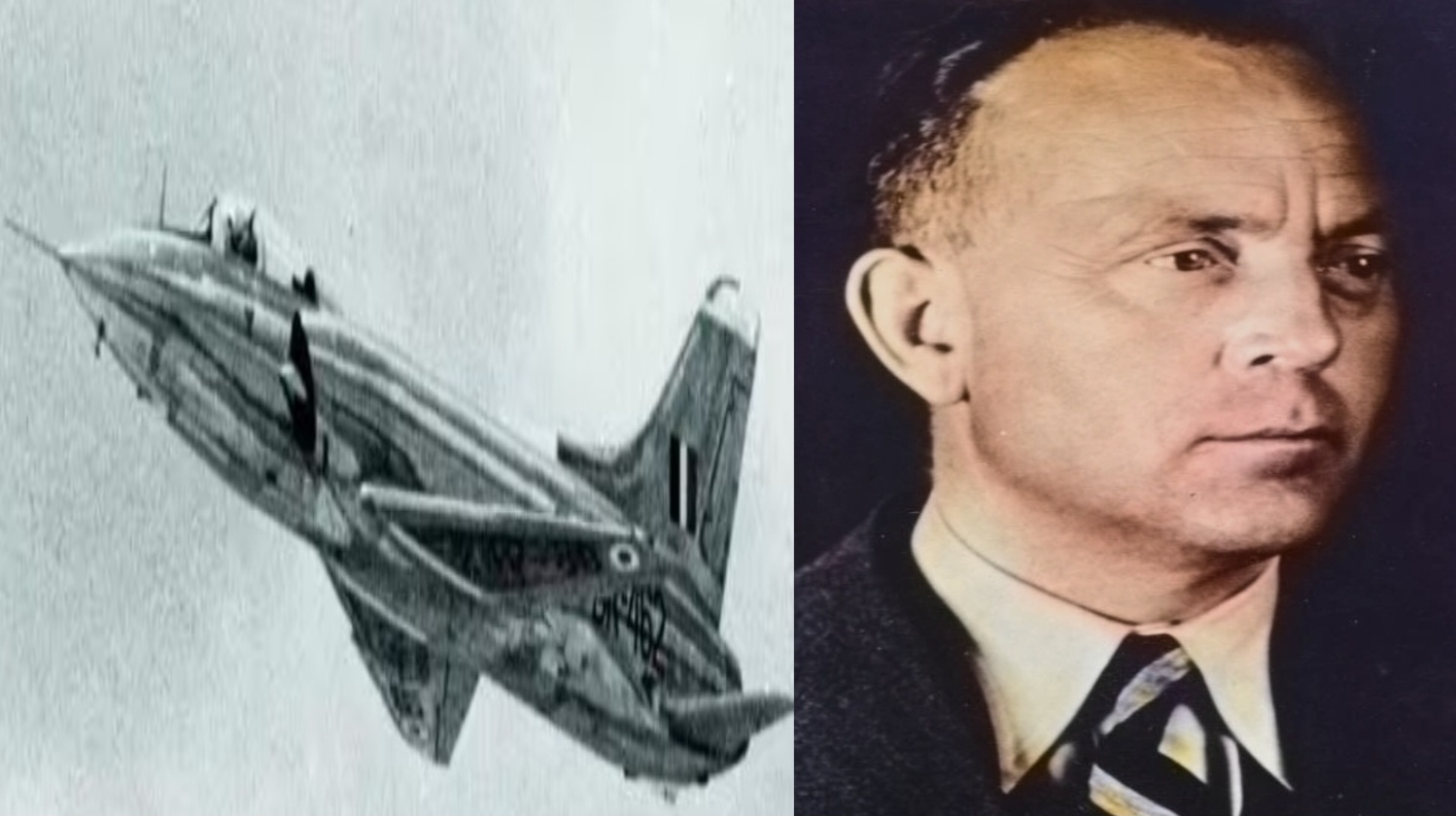
The story of the HAL HF-24 Marut is much more than just a mere plane; it’s a story of a nation’s struggle, ambition, and the first major step towards being self-reliant. It speaks to India’s deep desire for independence, the genius of its engineers, and the difficulties of international politics and technical challenges. It represents the spirit of a new, independent India, trying to take its first steps in the world of military aviation.
In the years after independence, a bold idea was forming. In 1956, the country, still trying to find its place, decided to stop relying on foreign military equipment. The Indian Air Force was using British-made “HAWK Hunters” and French-made “MYSTÉRE IV” jets. Learning from conflicts with Pakistan, the government realised that a truly independent nation needed its air power, not just foreign jets.
A group of visionaries at Hindustan Aeronautics Limited (HAL) started a project that would test the nation’s determination. It was a big challenge because India had no experience in designing supersonic jets, had a weak industrial base, and lacked skilled workers in aerospace. No other Asian country had done this before. The project was a big risk and a belief in India’s ability.
To lead this effort, they chose Kurt Tank, a famous German aircraft designer known for his work on the “Focke-Wulf FW 190” during World War II. When he arrived, there was no design team or proper infrastructure, just a strong desire to build something great. He helped create the design department, set up manufacturing, and trained a new generation of Indian engineers.
The plane was named “HF-24 Marut,” which means “Spirit of the Wind” in Sanskrit, a perfect name for a project that symbolised India’s spirit of innovation. Tank’s plan had two parts: first, to create an airframe that could fly at supersonic speeds, and second, to find a powerful engine to make that possible.
A wooden model was built for testing and completed 86 flight tests. On June 24, 1961, the first powered jet Marut took off, marking a proud moment for India as the first Asian country to design and fly its supersonic fighter.
Its design surpassed all the jets of its era. It consisted of a smooth aerodynamic frame that was ready for a powered supersonic flight. However, the project faced a sad ending. It was originally meant to use the British Bristol Orpheus engine, but NATO cancelled its development.
This left the Marut with no suitable engine. The search for a replacement became a political struggle with many problems. The Soviet Union offered an engine but gave false information about its lifespan, likely to protect its sales of the “MiG-21.” The US offered an engine, but with the condition that India stop all deals with Russia, which India refused. An agreement to use an engine from Egypt was also cancelled due to the “Six-Day War.”
Eventually, the Marut used an underpowered Bristol Siddeley Orpheus Mk 703 turbojet engine. This choice, made out of necessity, was a big setback. The Marut couldn’t reach its design speed, leaving its full potential unrealised. Lack of support from officials and the government led to the dream not coming true. The tank left India in the year 1968 and returned to Germany.
Despite its shortcomings, the Marut became a hero in the 1971 Indo-Pak War. It flew over 300 missions, showing strong durability and reliability. Its strong frame, built for speed and toughness, allowed it to take heavy damage and return to base, earning the respect of its pilots. The Marut played a key role in destroying Pakistani tanks and artillery, and in one case, even shot down an advanced F-86 Sabre fighter.
Three Marut pilots were awarded the Vir Chakra for their bravery, making the aircraft a legend in military history. However, its role ended due to high costs and a lack of political interest. The Indian Air Force, focusing on more advanced foreign planes, lost interest in the Marut. Production stopped in 1977, and the aircraft was officially retired in 1990. The Marut serves as a historical lesson, a reminder that a great dream requires not only brilliant minds but also strong support to truly take flight.
As we embrace the spirit of “Atmanirbharta” and move towards our vision of “Vikasit Bharat 2047”, we must be aware of the pitfalls-the errors of the past that may hold us back from our dreams. While we are at it, we must not forget to take pride in the achievements of our past, our grit and resilience with which we kept our heads high even amidst adversities.