In a decisive step reinforcing India’s defence self-reliance and strategic deterrence, Defence Minister Rajnath Singh on Sunday virtually inaugurated the BrahMos supersonic cruise missile production unit and the Aerospace Integration and Testing Facility in Lucknow, amid heightened military tensions with Pakistan following recent cross-border strikes.
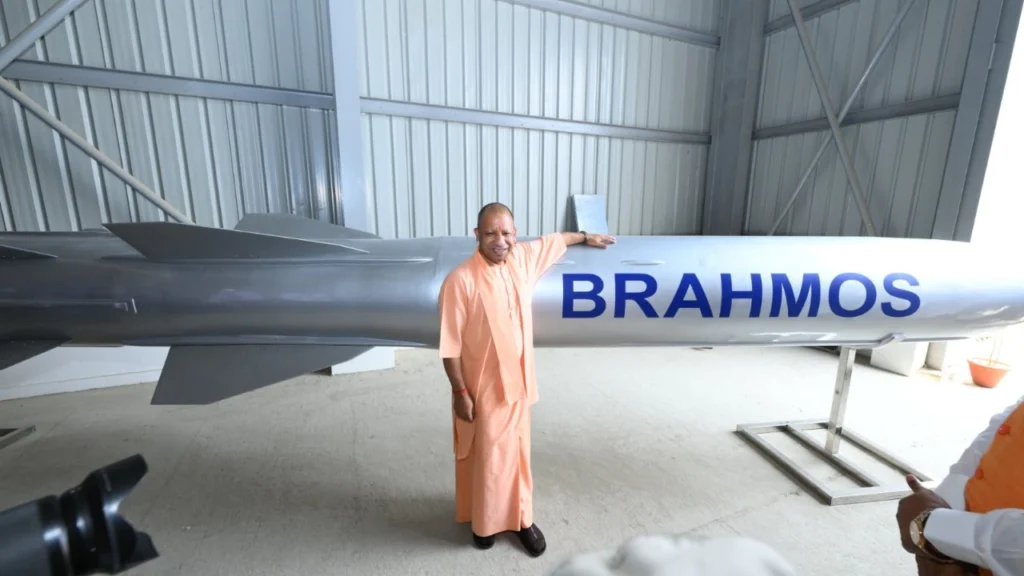
The newly operationalised facility—part of the Uttar Pradesh Defence Industrial Corridor (UP DIC)—is not merely an industrial milestone. It’s a sharp statement in India’s evolving military posture. Built at a cost of ₹300 crore on an 80-hectare tract provided free by the UP government, the unit is poised to produce 80 to 100 BrahMos missiles annually, along with 100–150 next-generation (NG) variants in the coming years.
The BrahMos: From Deterrent to Active Defence
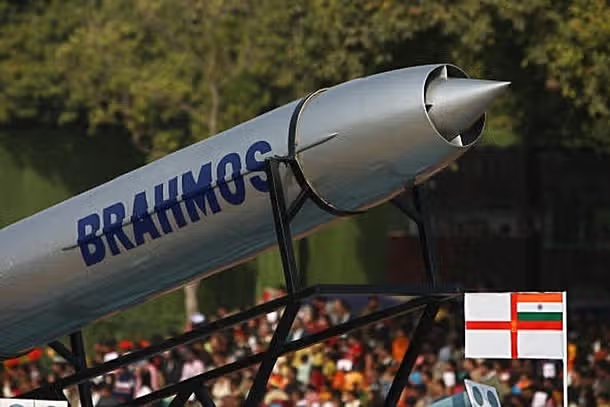
While India has long showcased the BrahMos missile as a technological marvel and credible deterrent, its alleged combat debut during Operation Sindoor marks a transformative moment. Uttar Pradesh Chief Minister Yogi Adityanath, in a bold declaration at the facility launch, said:
“You have seen a glimpse of the valour of the BrahMos missile during Operation Sindoor. And if the glimpse was not visible, then ask Pakistanis about the strength of the missile.”
His remarks, corroborated by defence sources and later reported by The Mint, confirmed that BrahMos missiles were used by Indian forces in retaliatory precision strikes on terror camps and military installations in Pakistan and Pakistan-occupied Kashmir (PoK), following the brutal terror attack in Pahalgam that claimed 26 civilian lives.
This is the first known instance of the BrahMos being deployed in actual combat—a major shift from its status as a deterrent to a battle-proven weapon system.
Rajnath Singh: “Operation Sindoor a Strategic Symbol”
Defence Minister Rajnath Singh, speaking virtually, underlined the broader implications of the operation: “Operation Sindoor was not just a military action, but a symbol of India’s political, social, and strategic will to fight terrorism.” In calling the missile facility a “leap toward Aatmanirbhar Bharat”, Singh also reiterated India’s dual commitment—bolstering indigenous defence manufacturing and reinforcing regional security.
The Future of BrahMos: Lighter, Faster, Deadlier
The Lucknow facility will produce the next-generation BrahMos, a lighter and more adaptable missile that extends India’s air strike capabilities. The new variant, weighing 1,290 kg—significantly less than the current 2,900 kg version—will allow fighter jets like the Sukhoi Su-30MKI to carry up to three missiles instead of one. Its operational range crosses 300 km, with a top speed of Mach 2.8.
Strategic Manufacturing Meets Industrial Vision
The project is part of a broader vision initiated by Prime Minister Narendra Modi at the 2018 Global Investors’ Summit, aimed at transforming Uttar Pradesh into a defence production powerhouse. With six active nodes—Lucknow, Kanpur, Jhansi, Aligarh, Agra, and Chitrakoot—the UP DIC is the second such corridor after Tamil Nadu’s.
Additionally, the inauguration saw the launch of a Titanium and Super Alloys Materials Plant, crucial for aerospace manufacturing, and the laying of the Defence Testing Infrastructure System (DTIS) foundation stone.
Yogi Adityanath, aligning defence capability with regional development, noted, “This lab will take the state in a new direction… and create immense employment opportunities for our youth.”
India’s Message to the World
Beyond defence economics and industrial growth, the timing and optics of this inauguration are unmistakable. As India faces renewed threats across its western border, the operationalisation of the BrahMos facility sends a clear message: India is not only ready to defend but to strike with precision and intent.
With its first confirmed combat deployment, the BrahMos has shifted from a Cold War-era deterrent to a 21st-century symbol of India’s assertive security doctrine.