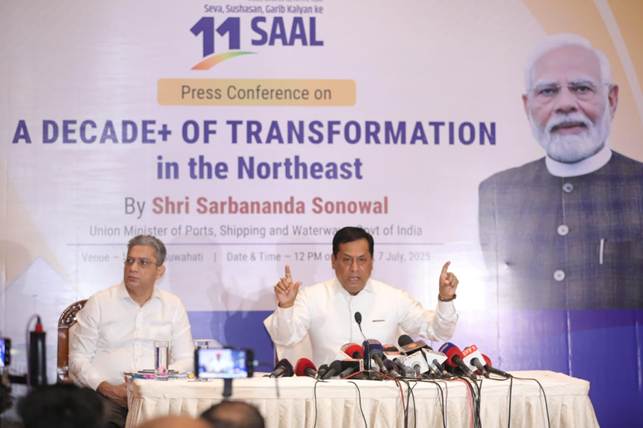
Union Minister of Ports, Shipping, and Waterways Sarbananda Sonowal launched a comprehensive development strategy of ₹5,000 crores in a historic move to transform the waterway network and maritime infrastructure in the Northeast. Speaking to reporters in Guwahati and New Delhi, the Minister announced initiatives meant to increase trade, youth employment, regional connectivity, and environmentally friendly transportation in one of India’s most strategically important areas.
Youth Empowerment through Maritime Skill Training
A primary emphasis on youth empowerment lies at the core of this plan. Over the next ten years, the government will provide maritime-related vocational training to 50,000 young people from the Northeast, offering them assured employment opportunities in this growing sector. This change would be spearheaded by the Maritime Skill Development Centre (MSDC) in Guwahati and an impending Centre of Excellence (CoE) in Dibrugarh. At least 500 new jobs are expected to be created annually by the ₹200 crore investment in the CoE alone.
“Modi ji has always envisioned how Yuva Shakti can bring about real transformation in the country. Our vision is to train, enable, & empower 50,000 youth from the Northeast with world-class maritime skills over the next decade, ensuring meaningful employment & growth. Our centres in Guwahati & Dibrugarh will be the backbone of this transformation,” said Sonowal.
Infrastructure Upgrades and New Waterways Projects
The ministry has already started projects worth ₹1,000 crore over the last two years, to improve the inland waterways industry in the Northeast. Of this, 300 crore worth of work has already been finished, and the remaining 700 crore is expected to be finished by 2025.
A new approach road to Pandu Port is currently under construction, and permanent cargo ports will be built at Pandu, Jogighopa, Dhubri, Bogibeel, Karimganj, and Badarpur. Additionally underway are ₹299 crore worth of tourism jetties and heritage restoration projects in Dibrugarh.
In order to improve local trade and connection, 85 community jetties will also be constructed in the Northeast. With a ₹610 crore expenditure, the government will deploy 10 amphibious and cutter section dredgers to guarantee the year-round navigability of important river systems.
“To unlock the true economic potential of the Brahmaputra and Barak rivers, we are investing ₹610 crore to deploy 10 state-of-the-art dredgers, ensuring all-weather navigability. This will transform cargo movement, create new trade routes, and strengthen economic linkages across Assam and the entire Northeast,” Sonowal said.
Global Logistics Boost with New Barges and Trade Routes
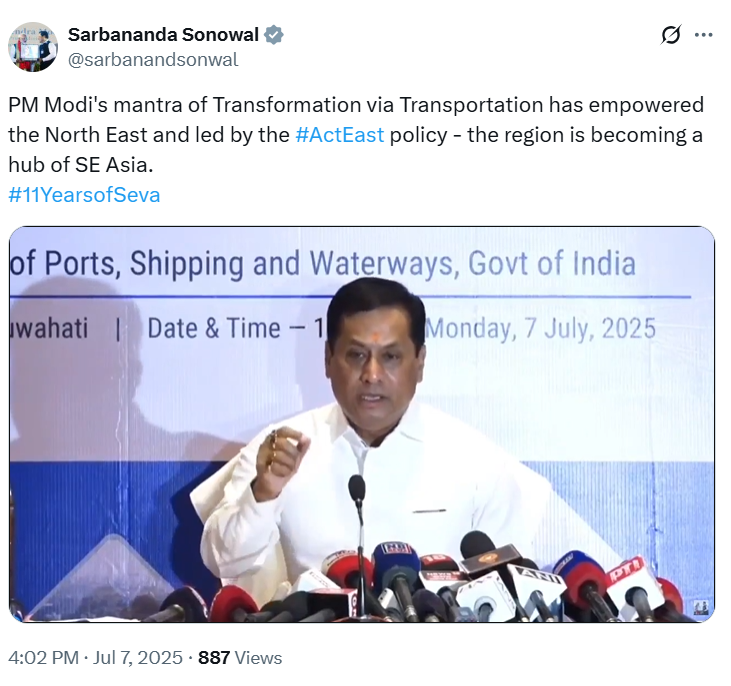
An important step taken is the deployment of 100 contemporary barges run by global logistics giant Rhenus. By 2025, these would significantly improve cargo movement throughout Assam and its neighboring states by operating on National Waterways 2 and 16.
Additionally, the Siliguri Corridor is being actively circumvented via the Indo-Bangladesh Protocol Route (IBPR), which lowers transit costs and times while facilitating direct economic connectivity with Bangladesh and Southeast Asia.
Kaladan Project to Open Global Sea Access by 2027
The key Kaladan Multi-Modal Transit Transport Project (KMTTP) is anticipated to be completely operational by 2027, an initiative that is the result of India Myanmar Friendship Treaty according to the Minister’s statement. Through inland waterways, the corridor links Sittwe Port in Myanmar with Paletwa, and then by road to Zorinpui in Mizoram.
“The Kaladan Multi-Modal Transit Transport Project is the result of the India-Myanmar Friendship Treaty. This is a strategic initiative to enhance connectivity between India’s Northeast and Myanmar—set to be fully operational by 2027. Once functional, it will open direct and shorter sea routes for Northeast India, Bangladesh, Bhutan, Nepal, and Myanmar,” said Sonowal.
He added that it would lead to significantly save time and logistical expenses by transporting goods from Kolkata to Sittwe Port in Myanmar to Teknaf Port in Bangladesh and then by road to Sabroom in Tripura. Rice, lumber, fisheries, petroleum products, and textiles are among Myanmar’s top exports, while building supplies will make up the majority of its imports.
Promoting Regional Tourism and Urban Transport
The government would invest ₹300 crore to build cargo and tourism jetties at Silghat, Neamati, Biswanath Ghat, and Guijan in order to capitalize on the region’s tourism potential. Additionally, feasibility studies for Water Metro projects in Guwahati, Tezpur, and Dibrugarh have already been finished. This is also a great step in the development of tourism in India.
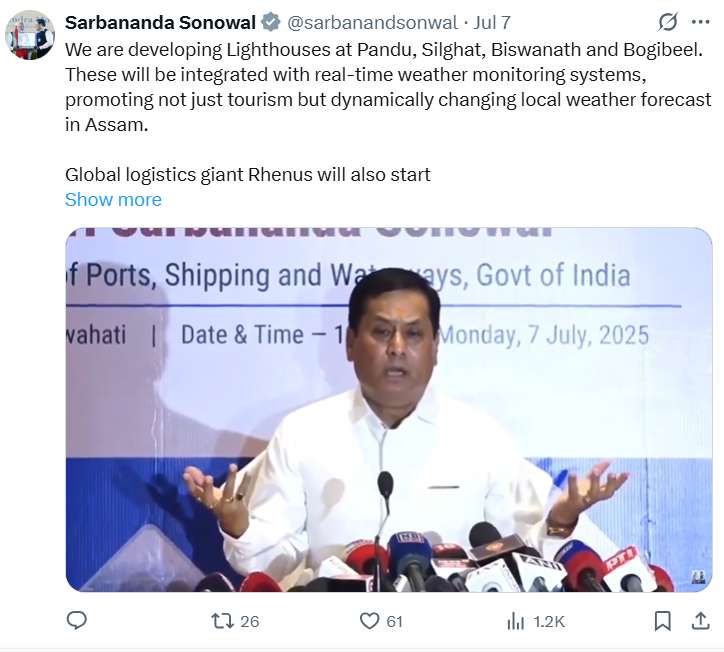
At Pandu, Tezpur, Biswanath, and Bogibeel, the government will erect lighthouses with IMD centers to improve weather forecasting and navigation safety. The Ministry of Environment, Forests, and Climate Change will assist these.
“These projects reflect our commitment to transform the Northeast into a major hub of waterways-based trade, tourism and employment, aligned with PM Narendra Modi’s vision of inclusive development,” Sonowal said.
Maritime Sector on Global Map
The maritime industry has grown at an unprecedented rate over the past 11 years under Prime Minister Modi’s direction, Sonowal added. India now has nine ports in the World Bank’s top 100, with Visakhapatnam Port ranking among the top 20 worldwide, major ports have almost doubled their capacity, and cruise tourism is growing with new terminals.
“Under the visionary leadership of Prime Minister Narendra Modi ji, we have revitalized India’s maritime sector as never before. From historic growth in port capacity and cargo handling to pioneering green shipping, cruise tourism, and skill development for our youth—these achievements reflect the Modi government’s unwavering commitment to make India a global maritime powerhouse and drive inclusive development across every coastal and riverine region,” Sonowal affirmed.
Along with improving the Northeast’s physical infrastructure, the government hopes to create jobs, improve trade relations, and further integrate the region into India’s economy while maintaining its distinct ecological and cultural identity.