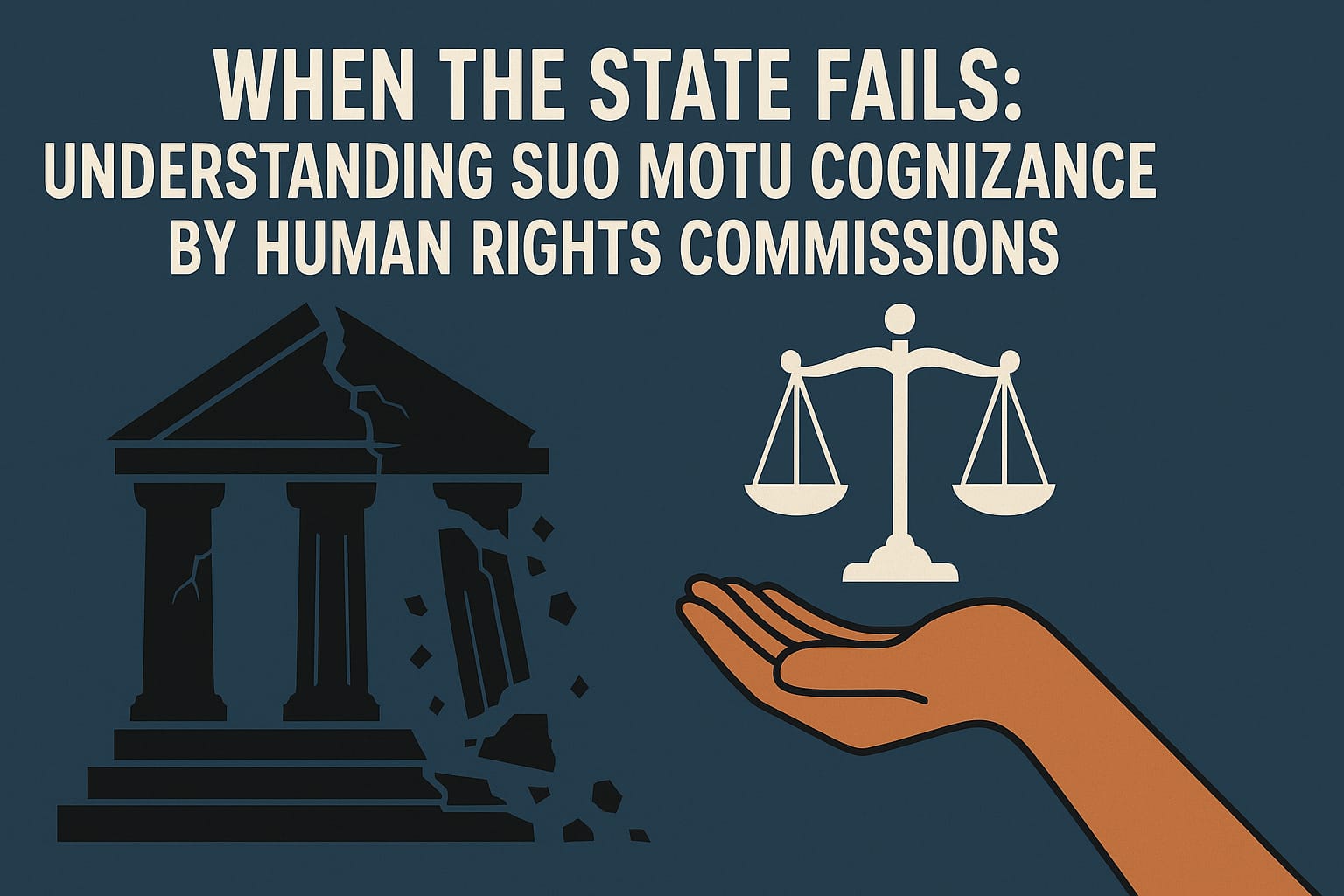
Democracy in a regime perceives human rights not only as legally warranted but also as warranted by institutions dedicated to the application of values under the provisions of the constitution. The National Human Rights Commission (NHRC) and the State Human Rights Commissions (SHRCs) guarantee a very critical function in protecting these rights when state institutions collapse, are engaged, or are becoming inefficient.
One of the most important powers they wield is the suo motu cognizance power, i.e., to act on their initiative without complaint. The power of taking initiative is especially useful in cases where the complainants are too sick, scared, or marginalized to come to them.
What is Suo Motu Cognizance?
Suo motu is the Latin expression for “on its own motion”. Judicial term refers to the jurisdiction of a court or a law to act suo motu, without complaint or petition. When Human Rights Commissions proceed suo motu, they initiate an active inquiry into the issues of violation of human rights on the basis of media reports, public information, NGO warnings, or even anonymous complainants.
Legal Framework and Institutional Basis
The Protection of Human Rights Act, 1993 (PHRA) confers suo motu powers on the NHRC and SHRCs. Section 12(a) of the Act confers on the commissions the powers to inquire into:
- Violation of human rights,
- Abetment of violation,
- Neglect by a public servant in evading such a violation.
Such suo motu jurisdiction authorizes the commissions to function as constitutional rights vigilantes even without a formal complaint being filed.
Why Commissions Act Suo Motu?
- Access to Justice for the Voiceless: Victims, especially from weaker sections (tribals, Dalits, women, children, prisoners), are ignorant about their rights or are terrorized out of fear of harassment. Suo motu powers help commissions bridge this lacuna.
- Duty of Public Authorities: In case of default on the part of the authorities or connivance in the breach of such rights, commissions do act suo motu without any reference to the aggrieved party.
- Media and Civil Society Reports: Commissions also act on media reports, documentaries, or fact-finding reports by NGOs exposing human rights violations.
- Prevention of Escalation: Intervention at an early stage can sometimes avoid a situation from escalating into a full-blown human rights crisis.
How Do Commissions Take Suo Motu Cognizance?
Step 1: Triggering Event
The judicial observation, media report, viral clip, NGO report, or social alert on social media gives rise to a possible violation.
Step 2: First Scrutiny
The law department or registry of the commission examines the information to determine if it warrants intervention.
Step 3: Registration of the case
A new case file is registered, and intimation is sent to the concerned officials/departments.
Step 4: Inquiry/Investigation
The commission can:
- Depute fact-finding teams,
- Conduct hearings or spot visits.
Step 5: Recommendations/Orders
If it is established that the violation has occurred, the commission can recommend:
Compensation to victims, Disciplinary action against the officials, and Policy-level reforms.
These recommendations are very high on moral and political authority but are non-binding in nature.
Key Suo Motu Action Examples
- NHRC in Case of Hathras Gangrape (2020):
NHRC suo motu acted in response to media reports of the victim’s dignity being denied at the cremation, police insensitivity, and custodial neglect.
- SHRC Tamil Nadu in Tuticorin Police Brutality (2020):
A father-son duo died in police custody on allegations of torture at the hands of police. The SHRC suo motu acted without waiting for a complaint.
- NHRC in Migrant Labourers During COVID-19 Lockdown (2020):
From news pictures of migrant hordes crossing borders and perishing, NHRC initiated proceedings against official complacency.
- NHRC in Delhi Riots (2020):
Suo motu proceedings were initiated for enquiring into police inaction, large-scale arrests, and hate speeches during communal riots.
Limitations and Challenges
- Non-Binding Nature: NHRC and SHRCs’ recommendations are devoid of binding juridical authority. States resist or ignore implementation.
- Limited Jurisdiction: Human Rights Commissions are not able to prosecute abuse by private parties unless there is negligence by public officials.
- Restraints of Resources: Inadequate manpower, insufficient finance, and dependence upon state agencies to inquire constrain effectiveness.
- Political Backlash: Central governments and occasional governments challenge the commission’s jurisdiction or coerce it to ignore their reports.
- Overlapping Jurisdictions: Various agencies (judiciary, police on the ground level, commissions) are investigating the same issue, which thus leads to delay or confrontation.
Censure and Call for Reform
Fault in Follow-up: Commissions initiate suo motu but fail to pursue the issue aggressively once initial hearings have been conducted.
Delays in Reporting: Reports are submitted only after it is withheld for long periods, losing strength.
Public Disillusionment: If the action doesn’t bring responsibility, citizens’ faith in institutions is lost.
Reforms Required:
- Empower binding powers on some of the recommendations.
- Facilitate follow-up within a reasonable time by oversight bodies.
- Increase autonomy with better appointments and adequate funding.
- Assure more coordination with civil society and grassroots groups.
Human Rights Commissions’ suo motu cognizance is an arm of justice when institutions cheat citizens.
In a scenario where the victims are most likely to remain mute or turned away, the suo motu exercise of powers promised hope and accountability to some extent. But only when reform upgrades the authority, credibility, and implementation capacity of such commissions can this mechanism realize its potential. It is only then that they can also serve as sentinels of the Constitution and protect the interests of the weak.