A titanic X2.7-class solar flare erupted from sunspot region AR4087 on 14 May 2025, racing toward Earth at light-speed and briefly knocking out high-frequency (HF) radio and short-wave communications across Europe, Asia and the Middle East. It was the strongest burst of solar X-rays recorded so far in Solar Cycle 25, surpassing the X1.2 flare fired off just 24 hours earlier. Scientists say the flare triggered a NOAA “R3 – Strong” radio-blackout event, but spared power grids from damage. Space-weather forecasters warn that AR4087 is still turning to face Earth square-on, raising the odds of more disruptive space storms in the days ahead. More information on solar flare classification can be found here: https://www.swpc.noaa.gov/phenomena/solar-flares-radio-blackouts
What Happened?
- 13 May: Sunspot AR4086 produced an X1.2 flare at 11:38 a.m. ET, already the year’s biggest at that point. NASA’s Solar Dynamics Observatory caught the blast in extreme ultraviolet light.

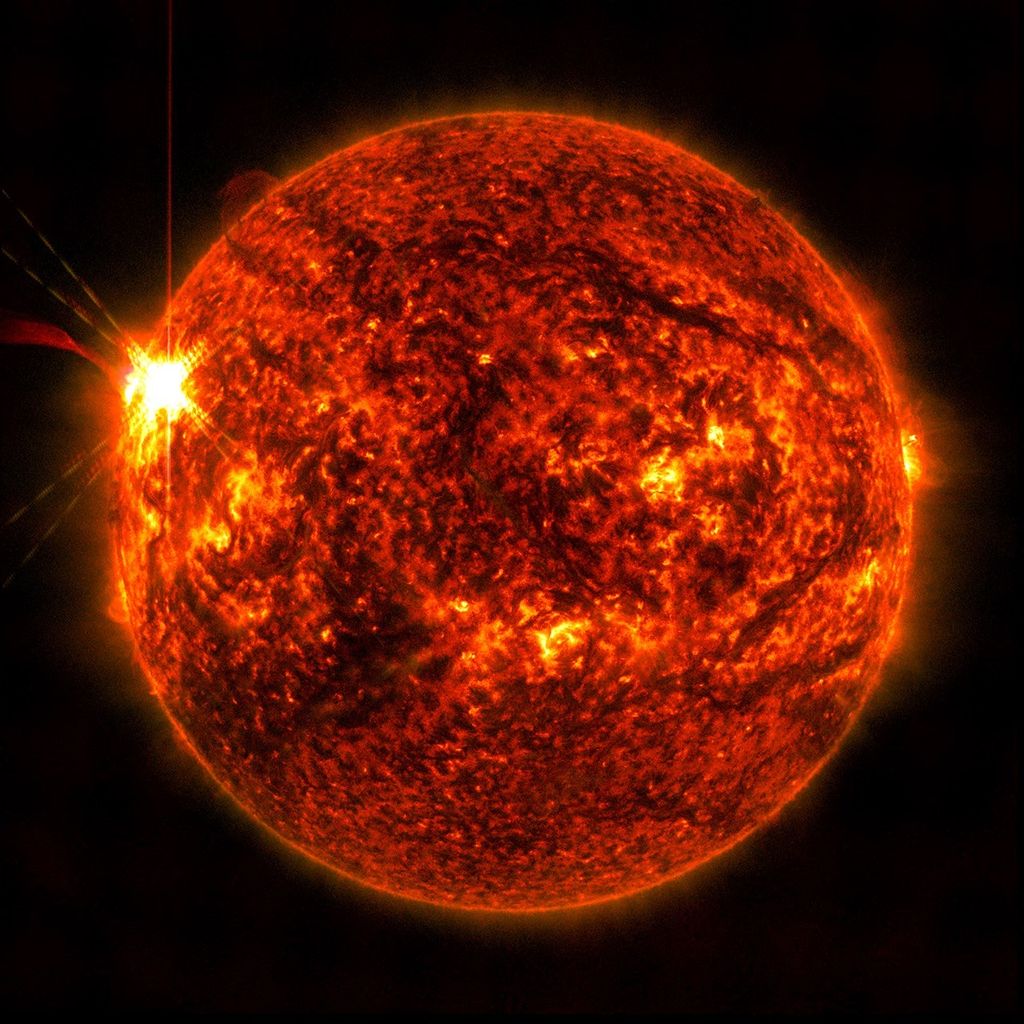
- 14 May: A day later, neighbouring region AR4087 unleashed an even stronger X2.7 flare, peaking at 08:25 UTC and hurling a torrent of X-rays at Earth.
Immediate Effects on Earth
- The X2.7 pulse ionised the top of Earth’s sun-lit atmosphere, causing a 45-minute HF radio blackout (NOAA R3 scale) over Europe, western Asia and northern Africa.
- Airline crews, mariners and amateur radio operators reported sudden signal fadeouts; some international flights were rerouted to maintain communications.
- No geomagnetic storm followed; X-ray flares travel at light speed, but the associated coronal mass ejection (CME) was tangential and is not expected to deliver a direct hit, according to NOAA’s Space Weather Prediction Centre (SWPC).
Why It Matters
Solar activity rises and falls in an 11-year cycle. Scientists predicted Cycle 25 would peak between 2024-2025, and these back-to-back X-class events confirm the Sun is approaching, perhaps surpassing, its forecast maximum.
Radio Blackout Scale

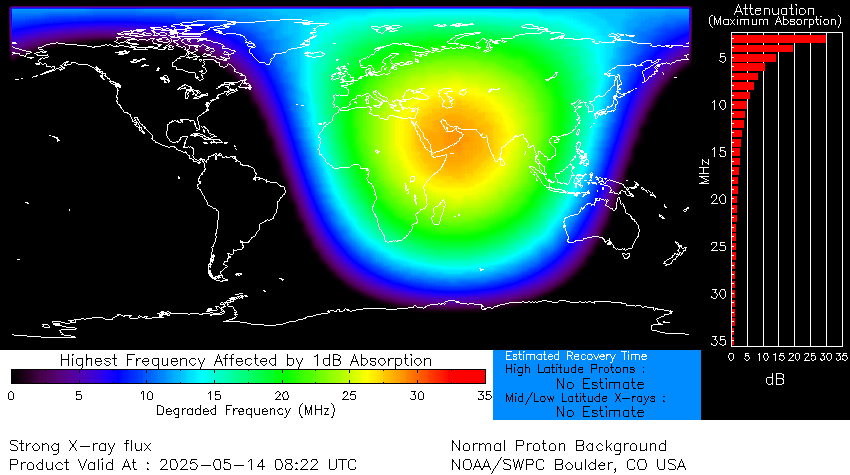
Image credit: NOAA Space Weather Prediction Centre
NOAA rates flares on a five-tier “R-scale.” An X2.7 corresponds to R3 (Strong)—powerful enough to degrade GPS, disrupt aviation and spark minor low-frequency navigation errors. An R4 or R5 event (X10–X20) could knock satellites offline and endanger power grids.
Watching AR4087
The culprit sunspot is 30,000 km wide, big enough to swallow two Earths, and will rotate directly Earth-facing over the next week. Each rotation could reload its magnetic fields and trigger fresh eruptions.
What’s Next?
- Forecast: SWPC gives a 35 % chance of another X-class flare while AR4087 remains visible. Satellite operators have been told to enter “safe-mode” stand-by procedures.
- Aurora Watch: If a future eruption launches a CME Earth-ward, vivid auroras could reach mid-latitude skies, think northern Italy, New York or Tokyo, much like April’s “cannibal” CME storm.
- Preparedness Tips: Airlines, utilities and satellite networks are reviewing contingency plans: switching to VHF backups, rerouting polar flights and throttling power loads to ride out geomagnetic surges.
The Bigger Picture

Flares like Wednesday’s are reminders that space weather is a natural hazard. While Earth’s magnetic field shields us from lethal radiation, the digital systems we rely on, GPS, timing networks, and internet backbone cables, remain vulnerable. Continuous monitoring by NASA, ESA and NOAA allows hours to days of warning. As Solar Cycle 25 intensifies, experts urge governments and industries to treat space-weather drills the same way they conduct earthquake or hurricane exercises.
“We’ve entered the stormy season on the Sun,” says SWPC lead forecaster Mark Miesch. “Wednesday’s flare was a wake-up call, not the main event.”