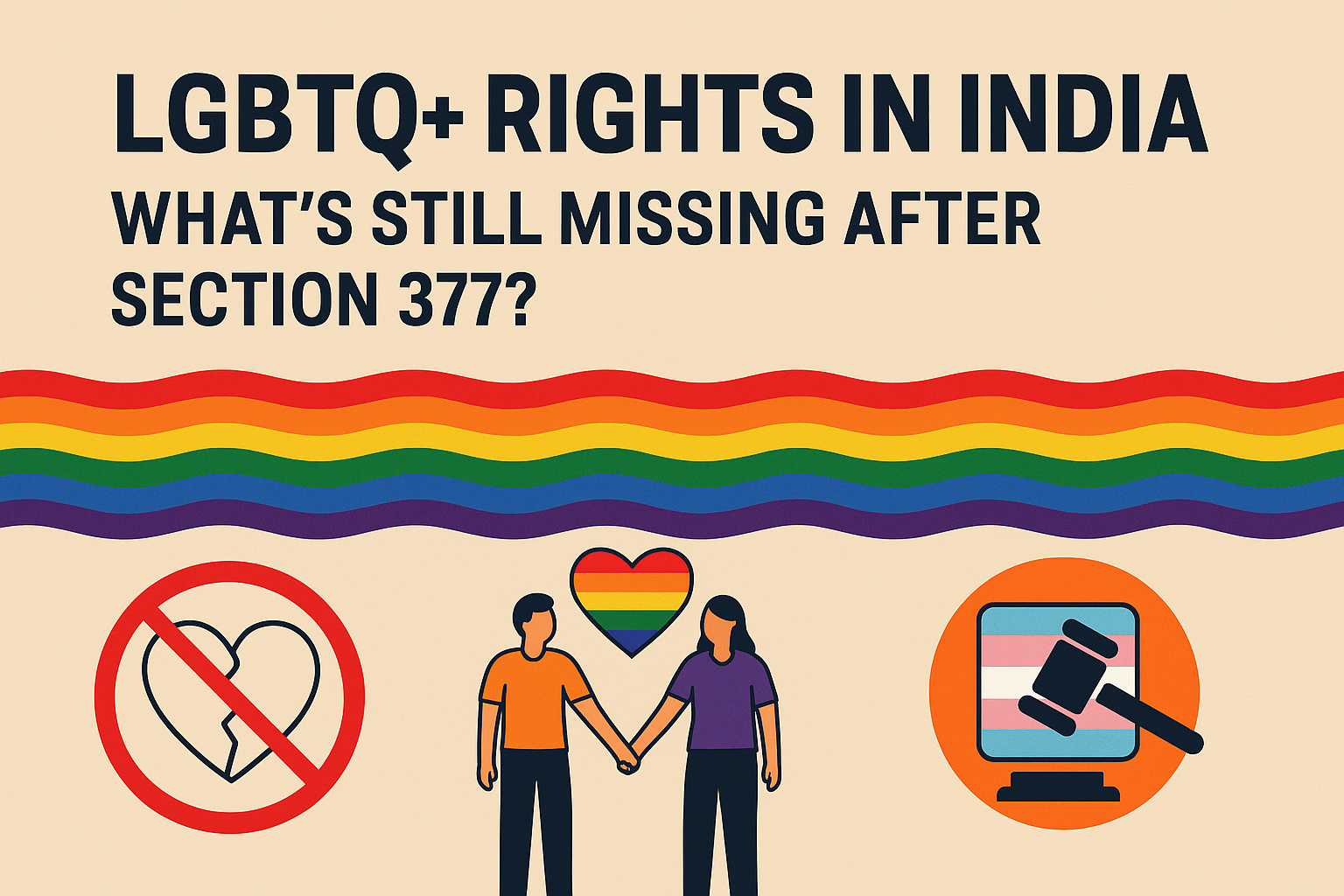
Legal Gaps After Decriminalization of Section 377
2018 Supreme Court ruling legalising Section 377 was a milestone in terms of LGBTQ+ rights in India. Gay sex among consenting adults was no longer a criminal activity. The ruling was embracing, yet there are some individuals belonging to the LGBTQ+ community who still face serious legal as well as social failures. What’s lacking now?
- Marriage Equality: Still Out of Reach
Criminalization having been shut, Indian gay couples have no entitlement to marriage. Existing legislation that governs marriage, religious personal law or the Special Marriage Act, are available only for straight marriage.
Official status denied, gay couples cannot avail spousal rights, joint bank accounts, medical insurance, tax exemption, and right of inheritance.
In a recent court case in the process of repealing the ban on gay marriages, the Supreme Court appreciated the dignity of the same-sex relationships but declined to make the change in law, noting that law reform of marriage should be provided through Parliament rather than the courts.
- Adoption and Family Rights
India’s adoption law is drafted such that same-sex couples are not mentioned. Single LGBTQ+ people are allowed to adopt, but two people of the same sex cannot adopt as a couple. Married heterosexual couples are privileged under the law when it comes to adoption and surrogacy, making it very hard for LGBTQ+ people to establish a family as a couple.
This judicial loophole leaves the child and homosexual couple’s non-adoptive parent in doubt about parental rights, guardianship, and inheritance.
- Lack of an All-Inclusive Anti-Discrimination Law
India lacks an anti-discrimination act per se on the basis of which one is safeguarded against denial of employment, home, education, and medical facilities on the basis of sexual orientation or gender identity.
On paper, protection is in place but in reality, LGBTQ+ individuals have a tendency to get singled out as the soft targets of discrimination, bullying, and prejudice in public as well as private life.
At work, for instance, the vast majority of LGBTQ+ workers fear coming out lest they suffer retaliatory assault or marginalization. Queer college and high school students are regularly subjected to harassment without much institutional basis for complaint.
A clear anti-discrimination law would introduce much-needed definiteness and enforceability to every sector of the economy.
- Respect for Diverse Families
But another gap is more obviously filled in that alternative family structures are not legally sanctioned. Gay and lesbian couples who live together or bear children have no legal right to be considered legal families.
This has implications for the receipt of welfare benefits, government assistance, health care decision-making, and property rights.
A wider, expansive definition of “family” must be invoked to legitimize and approve these unions and to be afforded an equal status.
- Concerns of the Transgendered Community
Although there certainly is a law on the books giving the rights of transgendered people, there is much that remains to be worked out. The law demands a bureaucratic or medical process in order to have the legal gender changed, as compared to the self-identification policy.
Transgendered people also continue to have problems with jobs, school, housing, and health care.
The trans community still lacks social welfare support, decision-making level representation, and legal redress against hate crimes and violence.
- Conversion Therapy and Hate Crimes
Conversion therapy, one of the most insidious dangers that the LGBTQ+ community still confronts, is a fatal process where to “cure” someone of their very sexual or gender identity. This anarchic process still remains unregulated by and large throughout much of India.
There is no such national law, however, making hate crimes against queer people a crime in so many words. Queer people, without specific protection, are more vulnerable to violence, police harassment, and social marginalization.
The Way Forward
The way forward is not merely legal change but also change of attitude. To move towards actual equality, India has to:
- Legalize same-sex marriage and civil unions.
- Grant joint adoption rights to LGBTQ+ couples.
- Pass a national anti-discrimination act.
- Expanding the definition of family under all legal and policy systems.
- Asserting the right to gender self-identification.
- Banning conversion therapy and holding perpetrators of hate crimes accountable.
While courts have had a pioneering role to play in expanding constitutional protections, now the legislature and civil society must follow this up and make LGBTQ+ rights a reality of life for people.