


New evidence indicates that the Iron Age might have begun in Tamil Nadu about 5,300 years ago.
Challenging long-held assumptions about the origins of the Iron Age, evidence has been found in a new study that the use of iron in the region of Tamil Nadu dates back to the first quarter of the 4th millennium BCE. Based on rigorous radiometric dating from multiple international laboratories, this revelation positions the region as a pioneering hub of early metallurgy, surpassing global timelines by nearly two millennia.
The findings, authored by K. Rajan and R. Sivanantham, are detailed in a Tamil Nadu report titled Antiquity of Iron: Recent Radiometric Dates. Rajan serves as a professor in the Department of History at Pondicherry University, while Sivanantham is the joint director of the Tamil Nadu State Department of Archaeology.
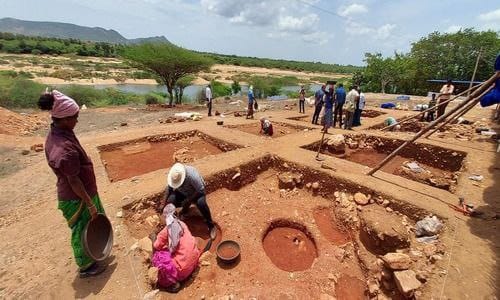
Supported by Accelerator Mass Spectrometry (AMS) and Optically Stimulated Luminescence (OSL) analyses, the findings reveal that iron technology in the region dates back to as early as 3345 BCE. These analyses were conducted on samples from archaeological sites including Sivagalai, Adichanallur, Mayiladumparai, and Kilnamandi.
New evidence significantly pushes back India’s Iron Age timeline, previously thought to begin between 1500 and 2000 BCE. At Sivagalai, dates range from 1155 BCE to 3345 BCE, marking the earliest global evidence of iron technology. Mayiladumparai samples date to 2172 BCE, while Kilnamandi revealed a sarcophagus burial from 1692 BCE, the earliest of its kind in Tamil Nadu.
Experts described this discovery as a landmark in Indian archaeology, establishing Tamil Nadu as a pioneer in metallurgy. Smelted iron findings, dated to the mid-3rd millennium BCE, represented the earliest known globally and reshaped the understanding of cultural development.
In a statement, Chief Minister MK Stalin emphasized that iron smelting technology originated in Tamil Nadu around 3345 BCE. He noted that samples were analyzed in top laboratories worldwide, including Pune and Florida. Describing the discovery as a source of immense pride for Tamil Nadu and its people, he called it a monumental contribution to humanity. He further reiterated his long-held belief that India’s history should be written from the perspective of Tamil Nadu.


