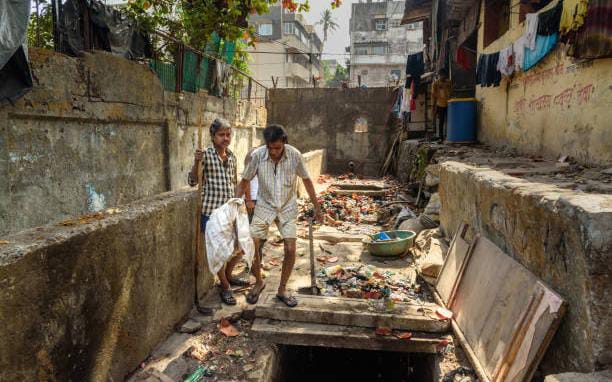
Manual scavenging involves the cleaning of human excreta from various sources, including sewers, septic tanks, by hand. Despite its ban since 1993, the practice remains a blemish on India’s social progress. It also remains a stark reminder of the country’s deep-rooted caste inequalities and a troubling contradiction to its claims of progress and modernity.
Who is a Manual Scavenger?
As per Section 2(g) of “The Prohibition of Employment as Manual Scavengers and their Rehabilitation Act, 2013,” a Manual Scavenger is a person who gets engaged or employed by an individual or a local authority, or a contractor to manually clean, carry, dispose or otherwise handling in any way human excreta in an insanitary drain(open or close) or pit, sewer into which human excreta from the insanitary septic tank is disposed of or even on a railway track or at any such other place or premises as the Central or State Government may notify before the excreta fully decomposes in such a manner as may be prescribed. The inhumane practice of manually handling and removing human excreta by a person is called Manual Scavenging.
This work is very dehumanizing; it is often forced on the marginalized sections of society, it disrespects human dignity, and it creates severe health risks, which include death from toxic fumes. The tenacity of this practice still showcases the deep-rooted issues such as caste discrimination, poverty, and improper sanitation infrastructure. As per the recent updates, it shows that while the government authorities claim progress, the reality on the ground shows a different story, with deaths happening and limited efforts being made for rehabilitation.
The people who are affected by manual scavenging work are people from marginalized communities, such as Dalits, with over 90% of the people belonging to the Scheduled Castes (SCs), Scheduled Tribes (STs), or people from Other Backward Classes (OBCs). The total number of women makes up 95 to 98% of scavengers; they face bigger marginalization and double disadvantage due to caste and gender.
What do the Reports Reflect?
The official numbers from the year 2018 report 58,098 manual scavengers, but as per the reports from support groups like “Safai Karmachari Andolan,” estimates are that the number could be as large as 770,000, which indicates a significant difference. Some workers, like Sanjay, a survivor who got disabled by the toxic fumes, show the personal loss from this hazardous work.
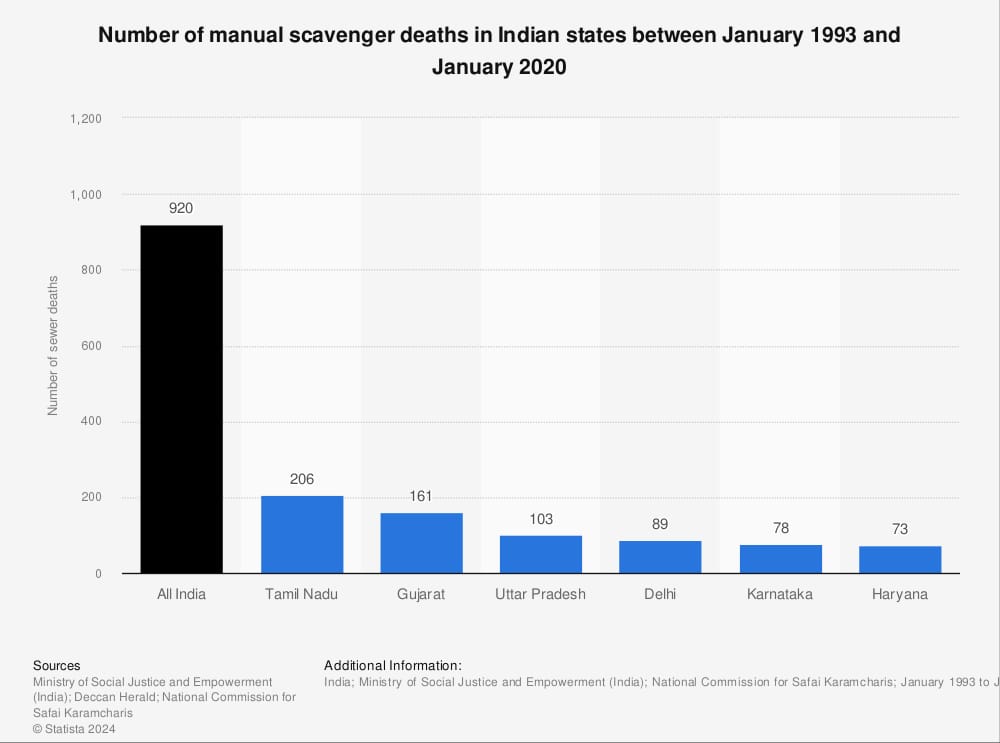
This issue persists across India; as per the recent data from July 31, 2024, it shows only 732 out of 766 districts are declared manual scavenging-free, which leaves 34 of the districts still affected. Some Indian states, such as Tamil Nadu, Uttar Pradesh, Haryana, Maharashtra, and Delhi, report the maximum deaths, which show 308 fatalities recorded between 2018 and 2022 due to sewer and septic tank cleaning.
In the year 2025, some posts on X reported that manual scavenging is continuing in the nation’s capital, Delhi, despite a ban on it by the Supreme Court in six major cities, which includes the capital. The rural areas are often overlooked, which account for 60% of the manual scavengers, as per the Self-Employment Scheme for Rehabilitation of the Manual Scavengers Survey.
The work of manual scavenging still continues due to the failure to handle the systemic issues. The institution of the caste system on Dalits in this work has maintained the social stigma and exclusion. There is a lack of alternative livelihoods for the workers who are trapped, as many are earning less than 300 to 500 rupees daily from this work.
The poor administration of the Prohibition of Employment as Manual Scavengers and Their Rehabilitation Act 2013 (PEMSR) allows illegal hiring by the private contractors and the local bodies. Irregular sanitation infrastructure, especially in rural regions, and the limited mechanization further sustain the practice. As per the government’s claim regarding no manual scavenging, stated by Minister Ramdas Athawale in July 2024, it fails to fulfill the ground realities, with the records of 339 deaths registered by “Safai Karmachari Andolan” from 2022 to 2023.
Steps taken by the Government? Are they Effective Enough?
The government has taken some steps, but loopholes persist. The PEMSR Act bans the work of manual scavenging and mandates the rehabilitation of the workers and the requirements of protective gear for hazardous cleaning work. The National Action for Mechanized Sanitation Ecosystem (NAMASTE) scheme has a motive for 100% mechanization by 2025-2026, but regarding its budget allocation in 2023-2024, Rs 100 crore was declared insufficient.
As per the Supreme Court’s ruling in the year 2023 (Dr. Balram Singh v. Union of India), there is increased compensation for deaths from the sewer work, which is Rs. 30 lakhs, and it also ordered rehabilitation measures, which include jobs and education for the families of victims. However, a 2024 Supreme Court hearing expressed concern at poor implementation and demanded an action report. The Swachhata Abhiyaan App, which was launched in the year 2020, allows the reporting of manual scavenging work, but still now only 6,256 cases have been uploaded there, and none of them have been declared valid by the government.
Way Forward:
The process of ending the manual scavenging work requires more than just laws and promises. As per the experts, addressing the caste-based discrimination, improving the sanitation infrastructure, and generating proper rehabilitation through skill training and creating alternative jobs are necessary. The use of technology-oriented solutions, such as robotic cleaning machines, which are built by the startups, shows promise but needs wider acceptance.
The Supreme Court has committed to eradicate this inhumane practice, declared in December 2024, creating hope, but in reality, it demands actual accountability and proper societal reforms too. The way India progresses, there must also be a priority for the dignity and safety of its most affected workers, which ensures that no one is forced into inhumane practices such as Manual Scavenging.