


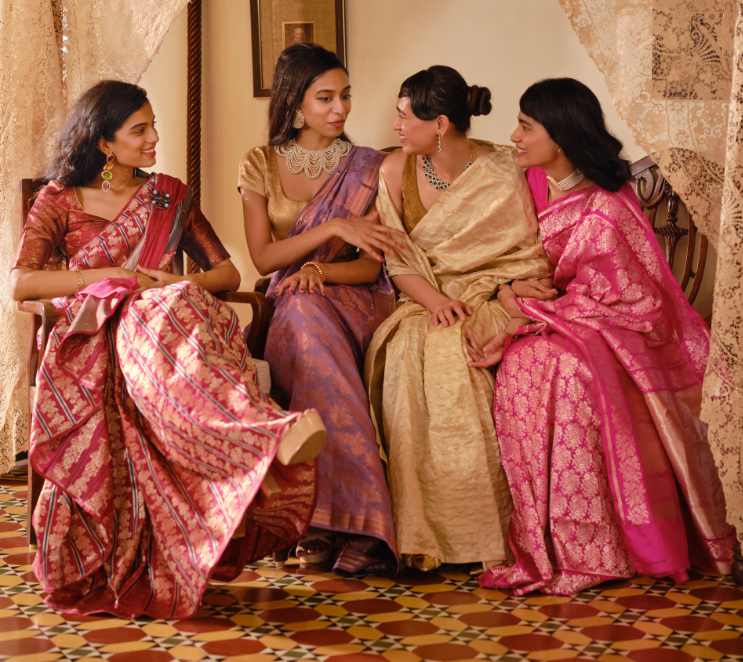
Sarees are a highly celebrated traditional garment for the women of India. The word saree originated from the Sanskrit word “Saadi”, which loosely translates to “a strip of cloth”.
A saree is a six or nine-yard unstitched traditional piece of cloth draped by women in the Indian subcontinent. It comes in a variety of prints, embroidery, a border, a decorated pallu, and vibrant colors, with each offering a distinct look and appeal. Saree draping styles, pallu, front pleats, borders, shoulder pleats, underneath skirts or petticoats, and matching blouses are the various components that make a saree complete and wearable. A saree can be draped in a number of styles depending on the tradition, culture, and region.
However, the sari is much more than a rectangular piece of fabric. This piece of fabric is a representation of Indian heritage. This timeless garment is an echo of our past, symbolising grace, elegance, and tradition. A lot is poured into the making of this ever-evolving garment, from the intricate weaving techniques, diverse saree material, craftsmanship, to regional variations, all of which highlight the rich textile traditions of India.
It is the prime example of the rich differences in India’s 29 states. The sari as we know it today exists in a multitude of forms: Mysore silks, Banarsis, Kanjivarams, Paithanis, Pochampallis, Patolas, Tanchois, Tangails, Jamawars, Balucharis, and many more.
Early historical records, such as seals and figurines found in civilisations of yore, namely Mesopotamia, Indus Valley, Egypt, and more, depict a common style of clothing worn by women. For example, the peepal tree seal from Mohenjo-Daro depicts women with tight-fitted skirts. In Harappan civilisations, the women wore a long unstitched piece of fabric that, after being draped around the waist, the wearer passed one end of the cloth or the centre pleat between the legs and tucked it up behind to facilitate freer movement of the lower body. This style of clothing was called kachcha style. These loincloths were only worn around the lower body, leaving the upper body bare, except in winter when animal skins or woollen shawl-like garments were used for protection from harsh weather. Therefore, it is likely that this simple loincloth worn by the women of the Indus Valley civilization was the early precursor of the saree of India.
In the Vedic period, the garments mainly included a single cloth wrapped around the whole body and draped over the shoulder. ‘Paridhana’ is a garment people used to wear in the lower part, which was pleated in the front and tied with the belt called ’Mekhala’, and the upper garment was called ‘Uttariya’. The Uttariya was mainly worn by flinging it over the left shoulder only; this style was called Upavita. Their winter garment was known as ‘Pravara’. The kanchuki, mentioned in many of the legends, was a piece of cloth worn across the breasts by women with sleeves and a neck. It was introduced in the later Vedic period. It was probably the earliest form of the choli.
The Mauryan-Shunga period sculptures from Bharhut and Sanchi depict women wearing a lower garment consisting of a piece of cloth where the outer edge is gathered into stiff folds of equal length. Neither women nor men wore an upper garment, with some rare cases of women shown in a thin bodice-like garment. The Bharhut and Sanchi relief sculptures also showcase women of all classes wearing the neevi or the length of cloth around the waist just below their navels, and for the first time, with the pleats hanging in the vikachcha style in front. The vikachcha style of wearing the neevi did away with the passing of the cloth between the legs and the tucking of the central pleats behind. Instead, a short decorative piece of cloth was draped around the hips and knotted in front. This piece was called the Asana.
In the Puranic age, women did not cover their heads as a traditional or religious requirement. The veils were worn only to enhance the beauty of elaborate hairstyles or to show off the bejewelled ornamentation on the veils themselves.
In the Kushana period, women wore tunic-like garments on the upper body and wrapped a cloth around their lower body, which was sometimes thrown over the shoulder.
Both Banabhatta and Kalidasa describe women’s clothing, including gatika (shawl) tied on the breasts, kancuka (tunic), candataka (petticoat) and dukula (sari covering the lower body).
Each of these periods has contributed to the evolution and variety of sarees we wear today all over India, with each style being a representative of its own cultural heritage, craftsmanship, textiles available and suitable for that region.
The most common and widely recognised traditional draping style is the Nivi Style Draping. It is a universal and versatile style that never goes out of fashion. This style involves neatly pleating the front portion and allowing the pallu to flow gracefully over the left shoulder.
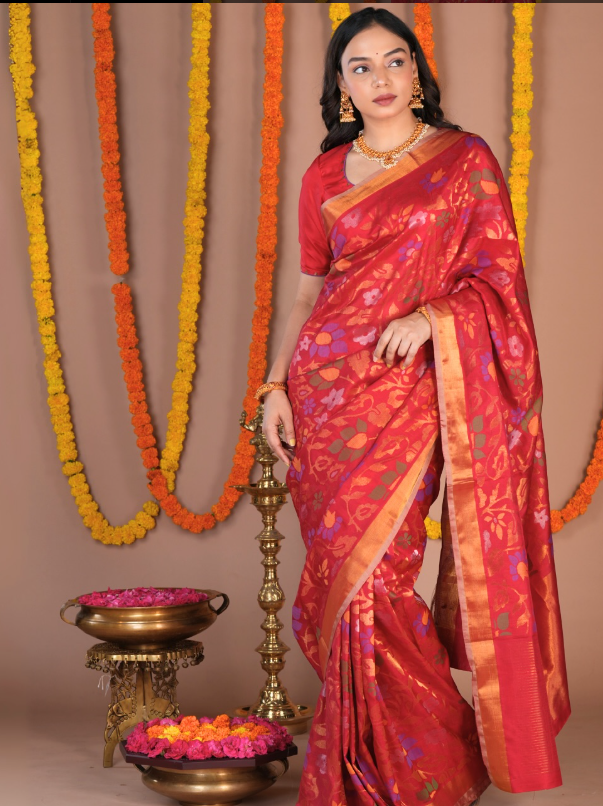
The Banarasi saree originates from Varanasi, an ancient city in the Bhojpur-Purvanchal region, which is also called Banaras. The sarees are among the finest sarees in India and are known for their gold and silver brocade or zari, finely woven silk and intricate embroidery, making them relatively heavy.
Kanjeevaram sarees, produced in the temple town of Kanchipuram in Tamil Nadu. The sarees are usually made up of silk fabric, vibrant colours, and contrasting borders, which are adorned with temple motifs.
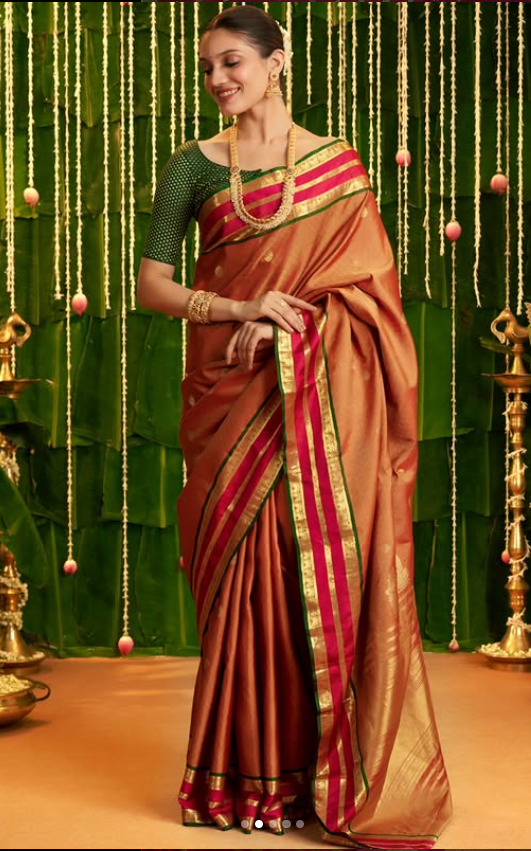
Originating from the colourful states of Gujarat and Rajasthan, Bandhani sarees are characterised by their tie-dye patterns. These sarees are perfect for casual wear and add a playful, youthful charm to any outfit. Gujarati Style Sari Draping consists of the pallu being taken from the back and brought over the right shoulder and spread across the chest. The Gujarati style incorporates multiple pleats, drapes the pallu over the right shoulder, making it a hallmark of Gujarati tradition. This style is also followed in states like Rajasthan, Bihar, Jharkhand and North India.
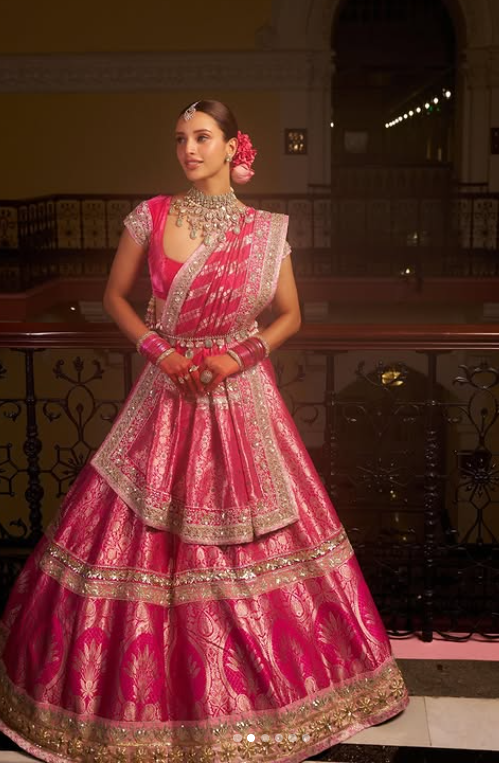
Produced in Chanderi, Madhya Pradesh, these sarees are celebrated for their lightweight and sheer texture. Delicate hand-woven motifs make them ideal for warm weather and casual occasions.
From the western state of Maharashtra, Paithani sarees are known for their intricate peacock motifs and vivid colours. This Maharashtrian drape style involves a shorter saree length and pins the pallu to the right shoulder. The other, more well-known Maharashtrian Saree is the Laavani Style saree, which measures 8 metres. One portion of the sari is lifted up between the legs and tucked behind at the waist, while another portion is draped as a pallu over the shoulder.
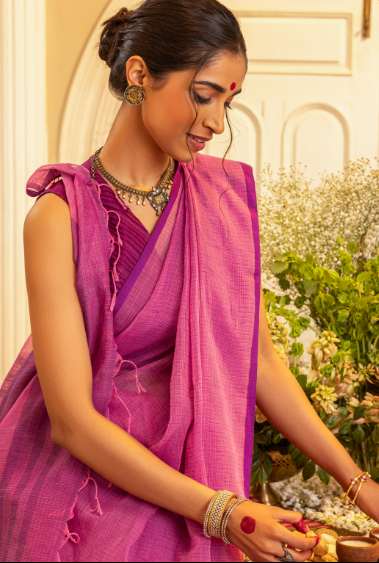
Bengali sarees are draped distinctively with box pleats in the front and the pallu wrapped in a circular manner around the body. Red and white sarees are particularly associated with Bengali culture.
In Kerala, sarees are generally draped in a two-piece style; the Mundu is draped on the lower part of the body, while neriyathu is worn over the left shoulder. This traditional attire’s colour usually ranges from pure white to cream with a gold border.
The Retro Style Sari Draping has a narrow border and 3 layers without the usual pleats. This draping style is also known as the ‘wrap-around’ style.
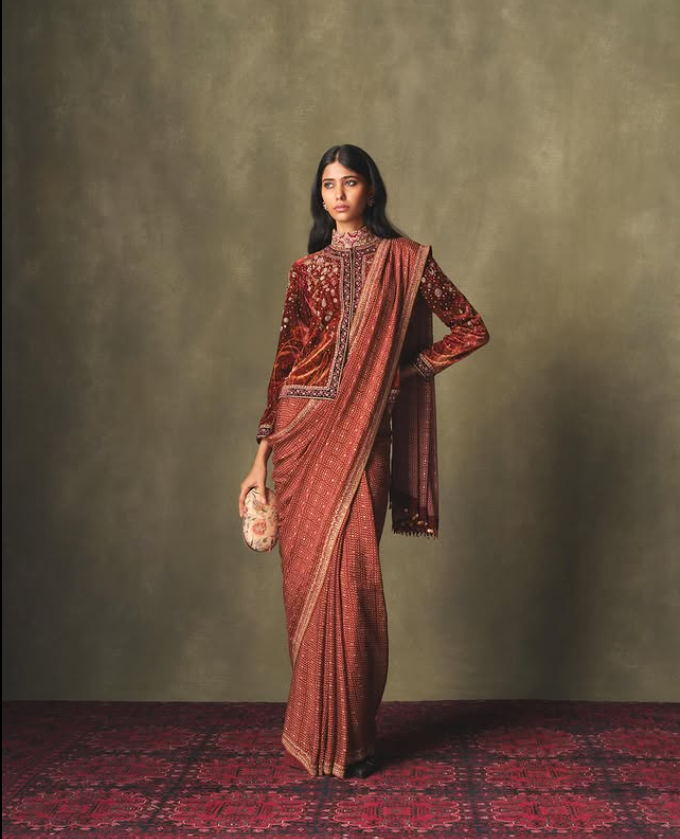
As for a smart-casual look, sporting a jacket with the sari has gained traction. Especially with the fashion designers going for a contemporary look. It is also known as the Jacket over saree draping style.


