The pristine concrete room of MOCA’s Geffen Contemporary has seldom seemed so electric. For a week and a half, Nadya Tolokonnikova artist, activist, and Pussy Riot founder occupied a mock prison cell with a defiant piece of performance art called Police State. Initially presented as an examination of authoritarianism via personal recollection, it evolved into an unsettling mirror of contemporary America.
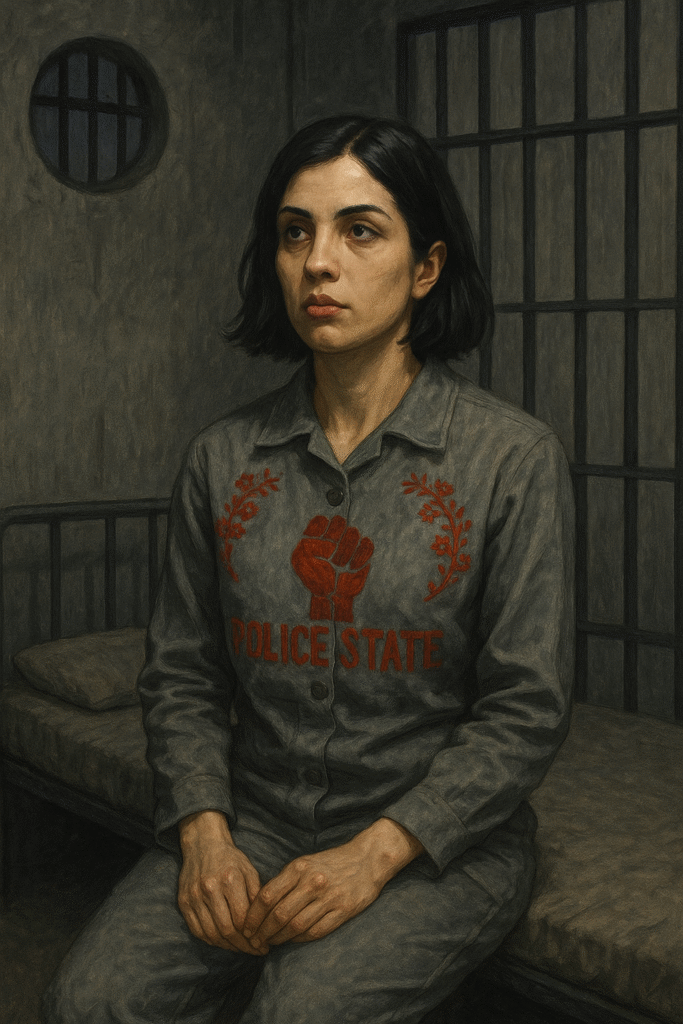
Tolokonnikova spent every day within the makeshift cell, re-staging the physical and psychological circumstances of her own actual ten-year imprisonment in a Russian penal colony. Wearing an embroidered protest prison uniform, under state-style observation, and with prison alarm and twisted lullaby soundscapes accompaniment, she created a dramatic visual spectacle of state control.
Yet the work’s power extended far beyond the gallery walls.
WHEN REALITY AND PERFORMANCE COLLIDE
While Police State was screening for seven days in Los Angeles, that city’s metropolitan region witnessed heightened ICE activity, especially in the garment district. When protests erupted against immigration sweeps in public areas, federal officials had deployed National Guard troops in the area, a decision that provided ironic real-world context to exactly the problems Tolokonnikova was attempting to critique.
MOCA was shut down temporarily due to safety concerns. Nevertheless, the artist stayed in her installation alone, deciding to remain “in character.” Instead of stepping back, she projected sounds of discontent into the cell: chants, sirens, and helicopters became a part of the work.
Looking back on the experience, Tolokonnikova describes that in retrospect the performance became something much more than a symbolic recreation of the past. Though she initially created Police State as an attempt at repetition of Russian-incarceration memory, the new political context of the U.S. turned it into a mirror held up to the American moment.
“It was supposed to be a simulation,” she said in an interview. “But being trapped in that space, listening to the protests outside and knowing the National Guard was deployed it felt like I’d stepped through a portal back to what I fled. Only this time, it wasn’t Russia.”
INSIDE THE INSTALLATION
The Police State installation was carefully rendered. Viewers looked in on the space through peepholes, faced with their position as voyeurs and observers. Paintings created by imprisoned Russian and Belarusian activists filled the walls, while illogical but menacing props—such as gumball machines with poisonous themes—represented state violence disguising itself as order.
A sound design station provided visitors with materials to blend prison sounds and lullabies, underscoring the grotesque doubleness of domesticity and tyranny.
One MOCA curator described the work as “a space that shifts responsibility onto the viewer. You’re not just watching Nadya—you’re witnessing your own silence.”
RESISTANCE AS RITUAL
Tolokonnikova did not break under pressure during the show. Even when the museum was closed, she stayed put, sharing the pandemonium outside with the cell. Her team posted updates online, too, like one that stated: “Police State exhibit closed due to the police state.” It was not lost on anyone.
She explained in post-performance dialogue that the show became more raw than anticipated. What began as a celebration of resistance turned into a live form of it. She termed the performance as “no longer metaphorical,” and explained that she felt the power that was coming down on her, not inside the museum, but from outside on the streets.
AN URGENT MESSAGE
Tolokonnikova’s work is more powerful than its symbolic resonance. In an era when American artists, educators, and institutions are being targeted more and more over political speech—book banning to defunding DEI initiatives—Police State is as much a warning as it is an invitation.
By putting her body back into confinement, she reiterates that art is not a statement. It is survival, protest, and witness. Her performance did not merely re-enact trauma; it challenged people to consider how similar the systems of oppression on both sides of the border are.
“Authoritarianism doesn’t always come with fanfare,” she noted. “Sometimes, it arrives quietly—in law, in policy, in silence.”
INSTITUTIONAL RESPONSE AND LEGACY
While MOCA declined to comment on the shutdown beyond citing “safety and logistical concerns,” the museum has since reopened. A virtual archive of the performance, including livestream footage and visitor reactions, will be available on its website later this month.
Art critics and human rights organizations have praised the piece for its bravery and immediacy. Dr. Ava Kaplan, a professor at UCLA specializing in art and resistance, called Police State “one of the most important political artworks staged in America this decade.”
“It’s not about past trauma,” Kaplan said. “It’s about what we are willing to ignore in the present.”
A PERFORMANCE THAT WON’T END
While the physical work has been completed, the Police State remains controversial across the country. Its live presence in generating new immigration protests was such that it couldn’t be restricted to the gallery.
Tolokonnikova’s performance of revolutionary nakedness, transforming performance into lived solidarity, reminds us that art doesn’t merely mirror society. At times, it stands against it.