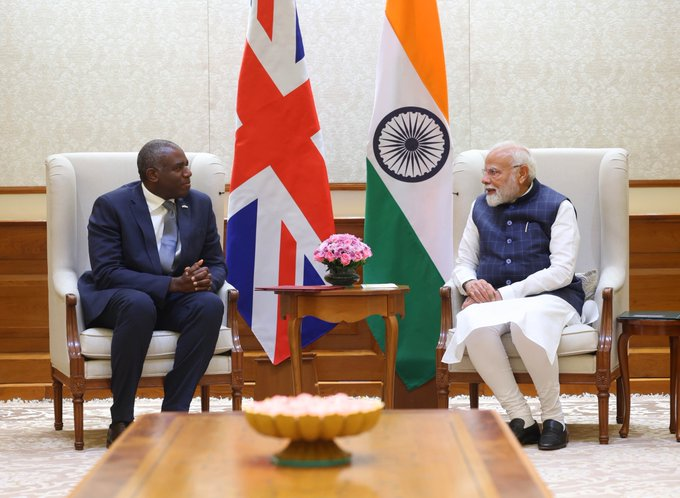
In a circle of history that once seemed closed forever, India, once a colony of the British Empire, has today emerged as an equal partner in a newly minted Free Trade Agreement (FTA) with the United Kingdom, signifying a diplomatic and economic rebirth.
Indian Prime Minister Narendra Modi received visiting UK Foreign Secretary David Lammy in New Delhi. The centrepiece of their meeting was the formal celebration of the recently concluded India–UK FTA, hailed by both nations as a landmark agreement boosting trade by an estimated £25.5 billion ($34 billion) by 2040.
Taking place in the stately corridors of Raisina Hill, the meeting echoed with historical resonance. This is more than an agreement; it is the closing of an era. India’s markets, once tightly guarded, are now opening to nearly all categories of British goods, from whisky and cars to medical devices, while 99% of Indian exports to the UK will enter duty-free. Prime Minister Modi described the pact as “ambitious and mutually beneficial”, while the UK’s Labour government called it their most significant trade deal since Brexit.
Foreign Secretary Lammy emphasised that this FTA follows three years of intense negotiations, only gaining momentum when the UK government under Prime Minister Keir Starmer joined the effort in early 2025 (theprint.in). As part of the agreement, both nations also ratified a Double Contribution Convention, easing taxation and social security issues for professionals moving between countries.
Beyond trade, Modi and Lammy affirmed mutual commitments on counter-terrorism cooperation, especially in light of rising tensions in South Asia. India reiterated its zero-tolerance policy on terror and welcomed UK solidarity following recent incidents in Pahalgam.