


After a biennium, the Eastern Zonal Council convened its meeting, presided over by the Union Minister for Home Affairs and Cooperation, Amit Shah. Zonal Council meetings are beacons of national harmony and an elimination of state identity, regionalism, glottophobia, and separatism.
This gathering marked the 27th meeting and was held in the Hotel Radisson Blu in Ranchi, Odisha. It was attended by delegates representing all four states within the Eastern Zonal Council, namely Jharkhand, Bihar, Odisha, and West Bengal.
Singing the praises of the Modi government, Home Minister Amit Shah affirmed that in contrast to earlier times when Zonal Councils were merely “discussion forums,” these have now transformed into an “engine of cooperation.” Shah shed light on the successful resolution of 1,287 issues out of 1,580 issues discussed in the meeting.
Underscoring the paramount importance of Zonal Council meetings, Shah illustrated that these meetings increased from 63 in 2014 to 2025, which was merely 25 from 2004 to 2014. The unsettled problems were reviewed in detail, such as Masanjore Dam, Taiyabpur Barrage, and Indrapuri Reservoir. The outstanding issues since the year 2000 related to assets and liabilities of public sector undertakings (PSUs) of Bihar and Jharkhand were also extensively addressed.
Jharkhand’s Chief Minister, Hemant Soren, presented 31 proposals, including a request for the disbursement of ₹1.36 lakh crore in pending dues by the Central Government associated with mining operations. Furthermore, the chief minister addressed the matter of pending payments by the centre and support for the Maiyan Samman scheme, a monthly financial aid initiative for women aged 18 to 50.
Torchbearers of liberty:
Spirituality, cognisance, melody, scientific studies, and rebellion are woven into the educational tapestry of Eastern India. Amit Shah noted exemplars like Netaji Subhas Chandra Bose, Swami Vivekananda, Dr. Rajendra Prasad, Birsa Munda Ji, and Babu Jagjivan Ram, who went the extra mile in various spheres of India.
Shah drew attention to the lion-hearted Birsa Munda Ji, who led the Munda Rebellion, also known as the Ulgulan, against the atrocities of landlords and the Britishers towards tribal people. Birsa Munda’s slogan, Abua raj ete jana, maharani raj tundu jana (“Let the kingdom of the queen be ended and our kingdom be established”), is still etched in the hearts of Indians.
TEAM BHARAT:
Amit Shah stated that based on an equal share of power between the centre and states, Prime Minister Narendra Modi has given the vision of TEAM BHARAT. Cooperative federalism promotes checks and balances, thereby cultivating a healthy environment for interstate and centre-state relations. He proclaimed to make India a fully developed country by 2047.
New Criminal Justice Framework:
During the meeting, Amit Shah emphasised the implementation of the Bharatiya Nyaya Sanhita (BNS), Bharatiya Nagarik Suraksha Sanhita (BNSS), and Bharatiya Sakshya Adhiniyam (BSA), which became effective on July 1, 2024. He also urged the states to collaborate in the execution of these three new criminal laws, which have superseded the Indian Penal Code (IPC), the Criminal Procedure Code (CrPC), and the Indian Evidence Act.
Shah advocated for Narco Coordination Centre (NCORD) meetings at the district level to battle the menace of narcotics and drugs. NCORD’s operational framework is structured across four tiers to streamline coordination efforts, encompassing the Apex Level NCORD Committee, chaired by the Union Home Secretary, and extending to District-Level Committees, led by District Magistrates.
Naxalism: A stitch in time saves nine!
Shah reiterated the vision of freeing India from Naxalism by March 31, 2026. He reminded that West Bengal is no longer in the grip of Naxalism. He explained that Jharkhand, Bihar, and Odisha have eradicated Naxalism to a significant extent due to the solidarity of states and the gallantry of security forces.
Projects discussed in the meeting:
Several projects were proposed for implementation across various states, including the following:
- Fast Track Special Courts (FTSC):
These specialised courts expedite the adjudication of cases of sexual offences, with a particular focus on rape and violations under the Protection of Children from Sexual Offences Act (POCSO Act).
2. Brick-and-mortar banking:
To enhance banking penetration and promote financial inclusion, the establishment of Brick-and-mortar banking branches in every village is considered essential.
3. Emergency Response Support System (ERSS-112):
This pan-India initiative, spearheaded by the Indian government, establishes a unified emergency number (112) for citizens to report all types of emergencies. The program integrates various helplines, including police, fire, health, and disaster management, onto a single platform.
Understanding Zonal Councils:
Zonal Councils are not constitutional bodies; rather, they are statutory bodies. Statutory bodies are established through legislation enacted by a parliament or state legislature, while constitutional bodies derive their authority from the Constitution.
The Zonal Councils were established under Part III of the States Reorganisation Act of 1956. The Fazal Ali Commission (States Reorganisation Commission) was formed in 1953 to reorganise Indian states based on linguistic and administrative factors. Its 1955 report led to the States Reorganisation Act of 1956.
The Union Home Minister serves as the chairman of the Zonal Council, while the position of vice chairman is held on an annual rotational basis by the chief ministers of the member states.

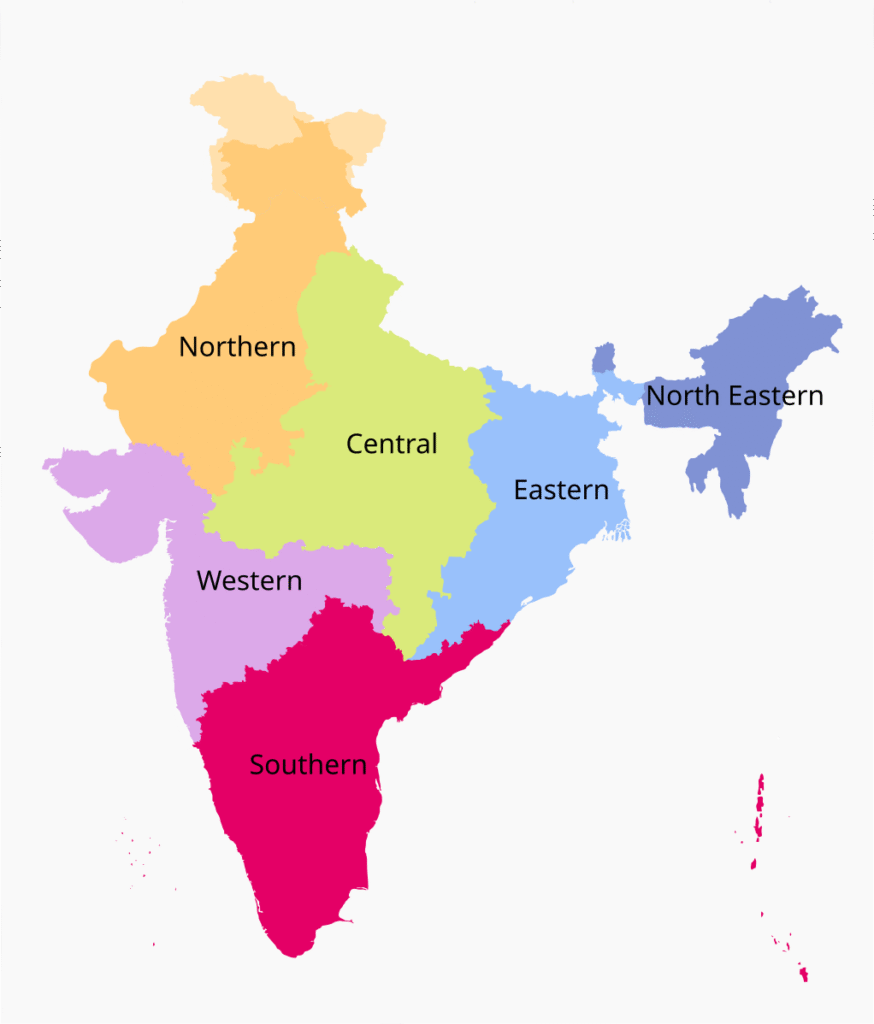
Zonal Councils in India:
Zonal Councils are the brainchild of the then Prime Minister Pandit Jawaharlal Nehru, who led to the establishment of five zonal councils in 1956. These are as follows:
- Northern Zonal Council – Haryana, Himachal Pradesh, Jammu & Kashmir, Punjab, Rajasthan, Delhi, and Chandigarh
- Central Zonal Council – Chhattisgarh, Uttarakhand, Uttar Pradesh, and Madhya Pradesh
- Eastern Zonal Council – Bihar, Jharkhand, Orissa, Sikkim, and West Bengal
[Sikkim is not part of the current Eastern Zonal Council] - Western Zonal Council – Goa, Gujarat, Maharashtra, Daman & Diu, and Dadra & Nagar Haveli
- Southern Zonal Council – Andhra Pradesh, Karnataka, Kerala, Tamil Nadu, and Puducherry
However, northeastern states were not included in these aforementioned Zonal Councils. Later, the sixth Zonal Council was introduced via the North Eastern Council Act, 1971.
This led to the emergence of the North-eastern Zonal Council, which comprises Assam, Arunachal Pradesh, Manipur, Meghalaya, Mizoram, Nagaland, Sikkim, and Tripura. Sikkim was removed from the Eastern Zonal Council and added to the North-eastern Zonal Council by an amendment in 2002.
Zonal Councils serve as a collaborative framework, facilitating the resolution of shared issues and the pursuit of common aspirations among participating states. Critics argue that Zonal councils can boost cooperative federalism, yet they remain underused.


