


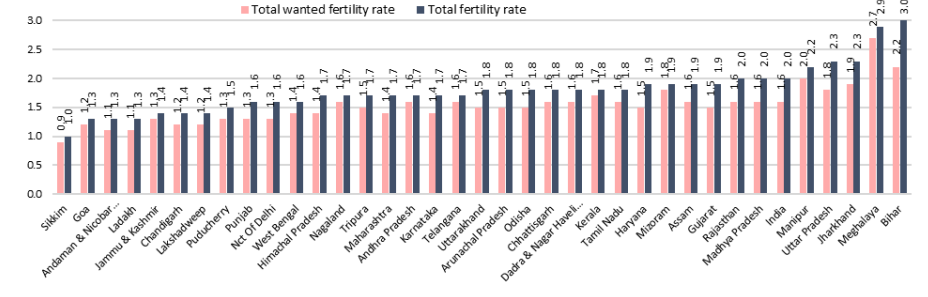
India is grappling with a dual fertility crisis, according to the UNFPA’s 2025 State of World Population report. India, the world’s most populous nation, has reached a total fertility rate of 2.0. In the 1970s, women on average had nearly five children. Now, they have close to two. This milestone reflects progress in health and education, but masks regional diversity in fertility rates—the average number of children a woman will have in her lifetime.
Fertility has fallen below the replacement level (2.1) in 31 states/UTs but remains high in Bihar (3.0), Meghalaya (2.9), and Uttar Pradesh (2.7). Urban-rural gaps persist, and seven states have yet to reach replacement TFR in rural areas.
The gap in realising their desired fertility goals is a reality for many individuals. Many want children but cannot have them when they want, while others want to avoid pregnancy but cannot. And both issues may affect many people in the course of their lifetime.

The report draws on UNFPA analysis and a YouGov survey covering 14 countries, including India, and was highlighted by Andrea M. Wojnar, UNFPA’s India representative.
Key findings reveal:
- 36% of Indian adults have experienced unintended pregnancies, and 30% couldn’t achieve their desired number of children—23% fall into both categories.
- Around 39% cite money as a barrier, 21% mention job insecurity, 22% point to housing issues, 18% cite insufficient childcare, and 19% feel family/partner pressure.
The report identifies stark regional contrasts:
- In high-fertility states like Bihar, Jharkhand, and Uttar Pradesh, unplanned and closely spaced births are common due to poor contraceptive and reproductive health services and gender norms
- In low-fertility urban centres like Delhi, Kerala, and Tamil Nadu, fertility has dropped below replacement levels, and many couples delay or skip childbirth owing to work-life conflict, especially among educated middle-class women.
UNFPA calls this a “real fertility crisis“, not rooted in overpopulation or demographic decline, but in individuals lacking the ability to decide freely on their family size. Persistent barriers in finance, employment, housing, healthcare, and social norms obstruct reproductive agency.
The report urges a shift in focus—from simply boosting fertility rates to empowering reproductive choice. Its key recommendations for India are:
- Expand affordable sexual and reproductive health services, including contraception and infertility care.
- Tackle structural barriers, like housing and childcare.
- Promote inclusive policies for all groups.
- Improve data systems to track reproductive autonomy.
- Change social norms through community engagement.
- Drive Social Change
With the changing fertility trends, India should further strengthen reproductive health policies and expand services with the twin aim to enable fertility choices both to achieve or prevent pregnancy at the right time for a woman, thereby upholding her reproductive autonomy throughout her life course. As the world’s most populous country, it can lead globally by integrating “demographic resilience” into its economic and social policy and planning framework—adapting to population
UNFPA 2025, INDIA INSIGHTS
changes while upholding reproductive rights.
With India projected to become the world’s most populous country (~1.46 billion) in 2025, as its total fertility rate dips below replacement, the report’s insightful framing offers a roadmap for sustainable demographic management. India must now balance opportunity and obligation, achieving the demographic dividend while ensuring reproductive justice.


