Repo Rate: The term “repo” is an abbreviation for repurchase agreement. Banks sell securities to the RBI with an agreement to buy them back at a later date for a higher price. This is usually done to ensure liquidity. In simple terms, it is the rate at which commercial banks borrow funds from the RBI.
Reverse Repo Rate: The rate at which the central bank, i.e. Reserve Bank of India (RBI), borrows money from commercial banks within the country. It is a monetary policy instrument that can be used to control the money supply in the country.
These rates are adjusted as part of the RBI’s monetary policy to control three key things: Liquidity, Money supply and Inflation.

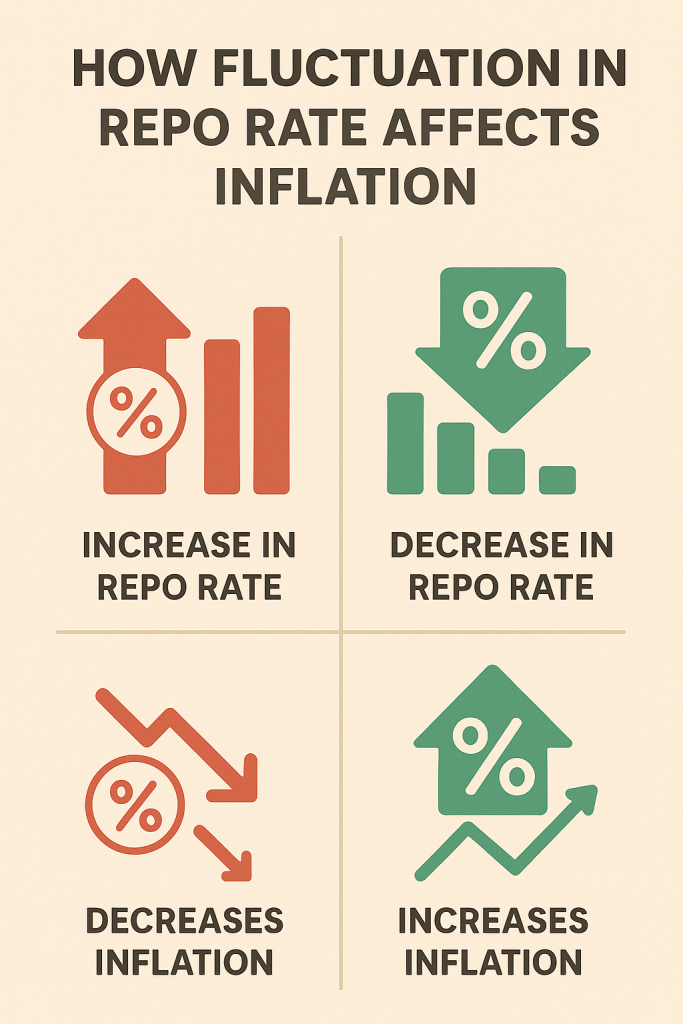
IMPACT ON INFLATION?
When the RBI increases the repo rate, it in turn causes commercial banks to have to pay more in order to borrow money. This leads to an increase in the interest rates on loans they offer to the public and businesses. This means home loans, car loans, personal loans, and business credit all become more expensive. This reduces the economy’s total borrowing and spending, which helps to control inflation by slowing the rate of price increases.
On the other hand, raising the reverse repo rate by the RBI contributes to the economic system’s liquidity. This strengthens the objective of the repo rate hike and aids in inflation control by further limiting the amount of money available for lending.
Usually, the RBI raises both the repo rate and the reverse repo rate

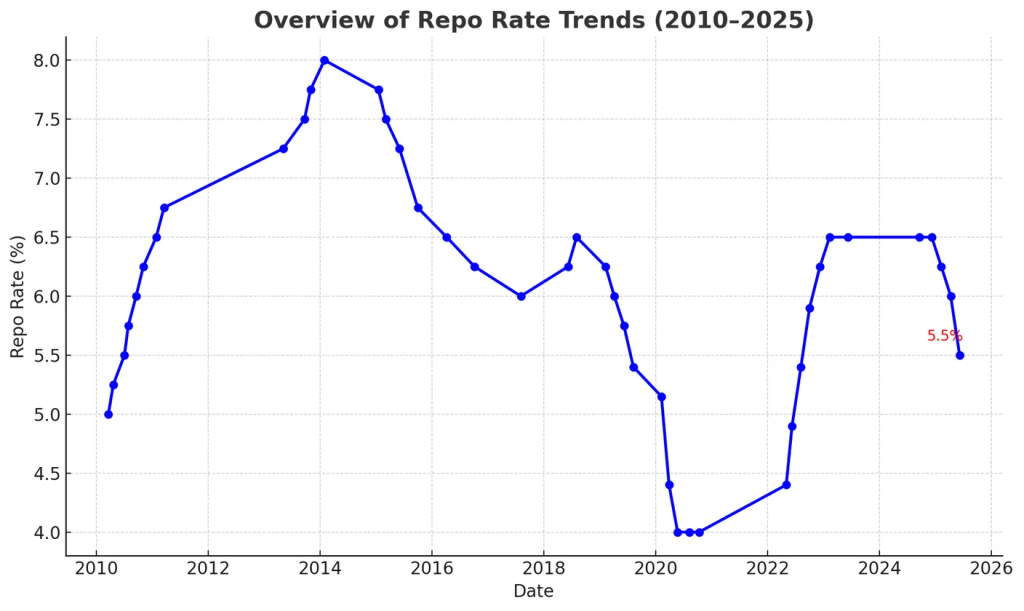
Here’s an outline of the trends in repo rates from 2010 to 2025:
Following the 2016 demonetization, the repo rate was decreased to support economic growth. This trend followed a period when rates were raised, which had peaked at 8% in 2013-2014.
Further, in order to boost the economy, the Reserve Bank of India lowered the repo rate to a low of 4% in 2020–2021, implementing historic rate cuts in response to the economic crisis brought on by COVID-19 lockdowns.
However, the post-pandemic period saw a surge in inflation, leading the central bank to revise its strategy. In an effort to slow price increases, it started a string of aggressive rate hikes, raising the repo rate to 6.5% by 2022–2023. As inflationary pressures have subsided in recent years, the repo rate was lowered to 5.5% in 2025 to encourage economic growth.
As a result, changes in India’s repo rates reflect the country’s economic trajectory, becoming tighter to control inflation and easing to promote growth. With future growth contingent on domestic demand, global trends, and prudent monetary policy for sustainable advancement, the 2025 cut to 5.5% signals a renewed expansion.