


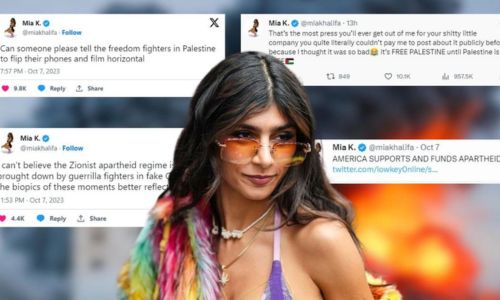
In recent times, Mia Khalifa, the former luminary of adult cinema, has ignited a substantial imbroglio through her entanglement in the Israel-Gaza conundrum. On the 7th of October, 2023, her Twitter missive, ostensibly benign upon initial perusal, enjoined Palestinian chroniclers of the ongoing strife to capture their footage horizontally, thus optimizing its visual fidelity. Yet, this ostensibly trifling entreaty bore profound ramifications, unearthing a veritable tempest of disapproval across the digital realm.
The repercussions stemming from Khalifa’s tweet materialized with celerity and gravity. Todd Shapiro, a Canadian disseminator, publicly severed his professional affiliations with Khalifa, deeming her tweet “genuinely abhorrent” and asseverating her implicit endorsement of violence and hostage-taking. Shapiro underscored the imperativeness of solidarity and empathetic camaraderie in moments of calamity, imploring Khalifa to engage in introspection and personal refinement.
In response to the burgeoning cavalcade of censure, Khalifa elected to employ the medium of social media to redress the maelstrom of controversy. She acknowledged that her pro-Palestinian advocacy had exacted a toll on her vocational prospects and expressed remorse for her apparent lack of circumspection in her interactions. Khalifa aspired to elucidate the intent behind her tweet, expounding that she intended to laud the Palestinians as “freedom champions” engaged in an ardent struggle for their liberty rather than endorsing any form of violence. She accentuated her aspiration to chronicle the emancipatory feats of Palestinians as they dismantled oppressive barriers, considering it an endeavor of historical significance.
Furthermore, Khalifa obliquely confronted Todd Shapiro’s verdict, offering her critiques of his choices while reiterating her unwavering solidarity with those battling against subjugation. She brought attention to her Lebanese heritage, vehemently decrying the scourge of colonialism, and underscoring that her stance transcended mere business considerations, embodying a principled resistance to an inequitable system.
It is imperative to situate this maelstrom within the broader context of the intractable Israel-Gaza conflict, an issue marked by its entrenched complexity. At the juncture of Khalifa’s tweet, the conflict had exacted a grievous toll, with nearly 1,600 casualties. Israeli Prime Minister Benjamin Netanyahu delivered a stern warning to Hamas, underscoring Israel’s insistence that while it did not instigate the hostilities, it was resolute in its determination to terminate them.
To conclude, Mia Khalifa’s ostensibly innocuous tweet pertaining to the Israel-Gaza imbroglio cascaded into far-reaching consequences, eroding a substantial professional engagement and engendering a tidal wave of opprobrium. Notwithstanding these tribulations, she steadfastly adhered to her stance of camaraderie with the Palestinians and provided elucidations of her intent. Meanwhile, the Israel-Gaza conflagration continued its ominous ascent, emphasizing the exigency of finding a resolution. This episode serves as a stark reminder of the potent influence and commensurate responsibility accompanying the mantle of a public persona on social media, whilst also spotlighting the labyrinthine nature of issues such as the Israel-Gaza conflict, which intricately interlace with the lives ensnared in its midst.


